Telemachus on the Road to Sparta

My brother and my son and I drive from Kardamyli to Mystras, the ruin of a fortified Byzantine town in the Peloponnese. We head north from the Mani, follow the coast around, stop for fuel in Kalamata, and then pick up the ancient road from Pylos to Sparta, the road which Telemachus and Pisistratus take by chariot at the end of Book III of the Odyssey.
It is a simple drive of two or three hours. But there are no simple journeys in this part of Greece. The road we want, the route Telemachus took, is up over the Taygetus Pass by way of the twisting EO82. None of our apps want to send up this way. They favour long slick diversions by motorway over the plains and broad valleys to avoid the knuckles and peaks of the improbable mountain range bending all roads where they do not what to go.
Or perhaps not improbable at all. An entirely predictable mountain range. Greece lies across the crumple zone between Africa and Europe, fresh young mountains being thrown up everywhere, morphing under our feet as we stand on them, up up up, Pyrenees to Alps to Carpathians, the Taygetus range we are driving over now, Balkan ranges to the north of us, those uplands behind the Côte d’Azur; all tracing the rapid progress of a great collision. These are sharp, youthful mountains, mountains of extremes, jagged uplands and down-pitching valleys; giddy mountains delighting in the morning of mountain life, not the slow old mountains of our home in the distant north, tired mountains worn down like ancient teeth, wise and sad, bearing long, deep, glacial scars.
We locate the turning for the EO82, our apps furiously recalculate their routes. And up it we drive, father, uncle, son, pitching towards Sparta on the far plain.
...
Telemachus makes this journey in a couple of days. Emily Wilson concludes Book III of the Odyssey, and begins Book IV, like this:
…Telemachus got in the lovely carriage;
Pisistratus, the son of Nestor, followed,
and sat beside him, taking up the reins,
and whipped the horses. Eagerly they flew
off for the open plain, and left the town.
All day they ran and made the harness rattle.
At sunset when the streets grew dark, they came
to Pherae, to the home of Diocles,
son of Ortilochus; Alpheus was
his grandfather. They spent the night as guests.
When rosy-fingered dawn came bright and early,
they yoked the horses to the painted carriage,
and drove out from the gate and echoing porch.
At a light touch of whip, the horses flew.
Swiftly they drew towards their journey’s end,
on through the fields of wheat, until the sun
began to set and shadows filled the streets.
Book IV
They came to Sparta, land of caves and valleys,
and drove to Menelaus’ house.
Here is a lot of youthful energy: got in – lovely – eagerly – flew – open – light touch – flew – swiftly. Emily Wilson evidently knows what it is to skitter off on a chariot at dawn on a youthful, unsupervised adventure. Robert Fagles gathers even greater energy into his translation: he has Telemachus vaulting on to the splendid chariot; Pisistratus whips up the the team to a run, holding nothing back; ‘so fast those purebread stallions raced them on, as the roads of the world grew dark.’ Look into George Chapman’s version, and you have horses which are ‘willing flying steeds / Who strenuously perform’d their wonted speeds’, while for Alexander Pope, Pisistratus ‘lash’d the coursers, and the coursers flew./Beneath the bounding yoke alike they held /Their equal pace, and smoked along the field.’
And then there is the original. The Greek, so far as my poor Greek can make out, has the youths jumping up on chariot boards, setting things in motion (or, possibly, some unspecified business with olive trees), flying without constraint over the plain; and doing it all, straightaway, without hesitation.
But all of them, translations and original, in capturing the buoyant rapidity, elide the journey itself. The journey is just a getting somewhere fast. It is compressed into a few lines. And yet those youths, you surmise, on that journey over the mountains, felt not just fleet and buoyant, but as expansive as the great world which rolled beneath their chariot’s wheels. Because that is the nature of youthful release. The boys are flying from the palace of one old king to that of another, but for a couple of sun-filled days they are just smoking along the wide open country.
There go Telemachus and Pisistratus then, and there go we alongside them, feckless and free.
...
We never make it to Sparta. We get scuppered in that Byzantine wreck of a city, my brother and my son and I. Mystras. From which we look down on modern Sparta. We have lost a little the thread of the logic of Pylos-Sparta. Lost it up here in the crazy mountains. But that is OK. We are not Telemachus and Pisistratus. We have no mission. We sit up in the hills of Byzantium, looking down on the ancient plain, the modern town.
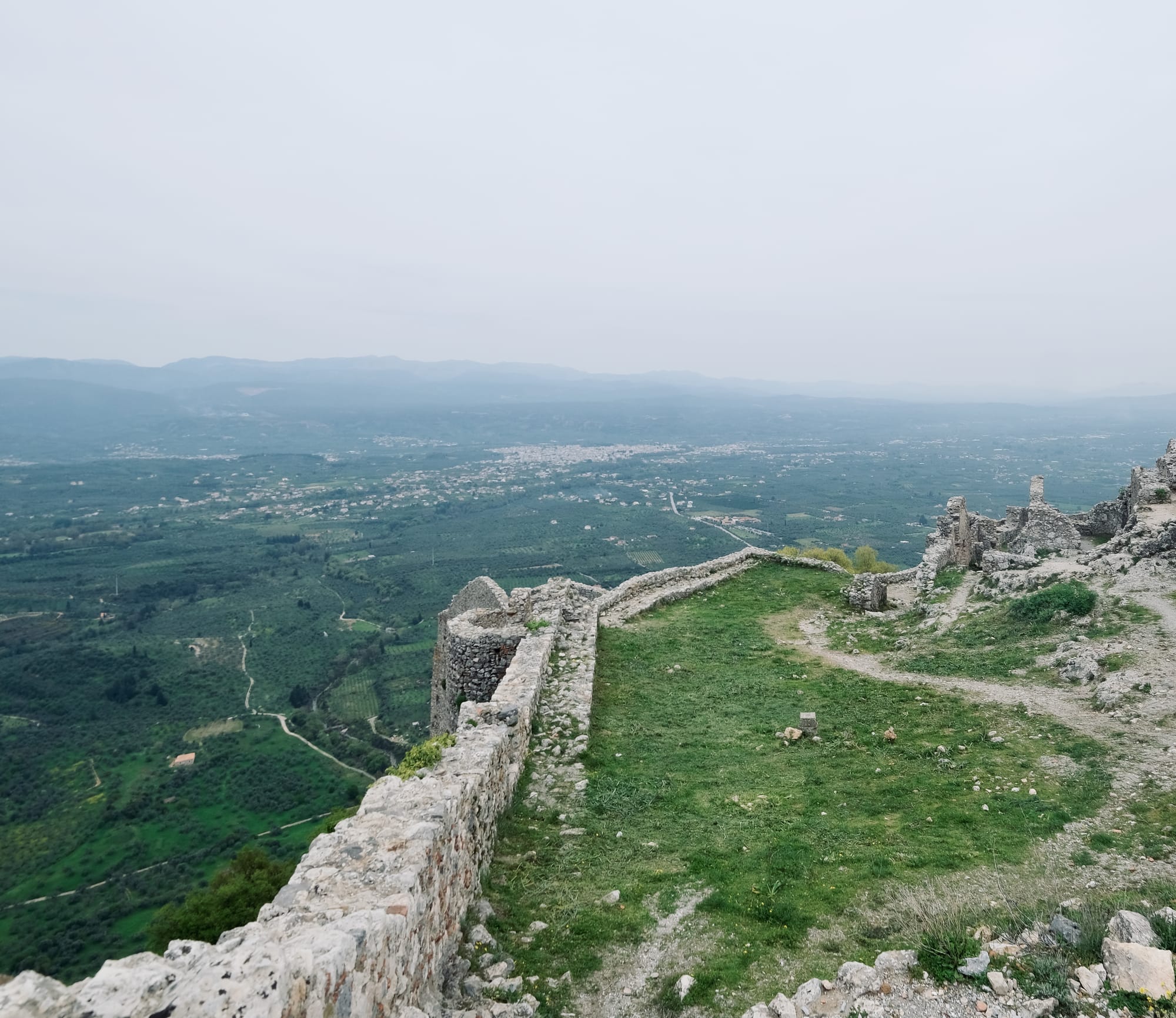
Sparta is where Telemachus goes to hear news of his father, but in the process hears also of change, transformation. Sparta was the city of Menelaus, who also had a difficult homecoming. He spent eight years wandering the eastern Mediterranean and North Africa, a victim of storms and calms brought about by the imperfection of his hecatombs, his indecorous hurry to leave the beaches of Troy. In order to find his way home, Menelaus learnt that he should trap the god Proteus on the island of Pharos off the coast of Egypt, and wring answers from him. And so he wrestled the changeable old god, Menelaus the man himself unchanged, until, exhausted, the old god gave up his secrets.
We no longer know how we offend or delight the gods, who thwart or favour our progress and purposes. There is no Proteus we can trap, pin down, trick into spilling the truth of things. Thus, I suppose, we end up not in Sparta, but looking down on it over several miles of plain. In our Protean journey, as we gripped and wrestled the wheel of the car, Greece morphed beneath our wheels from Mycenaean to Byzantine to, at the midpoint of our progress, Communist.
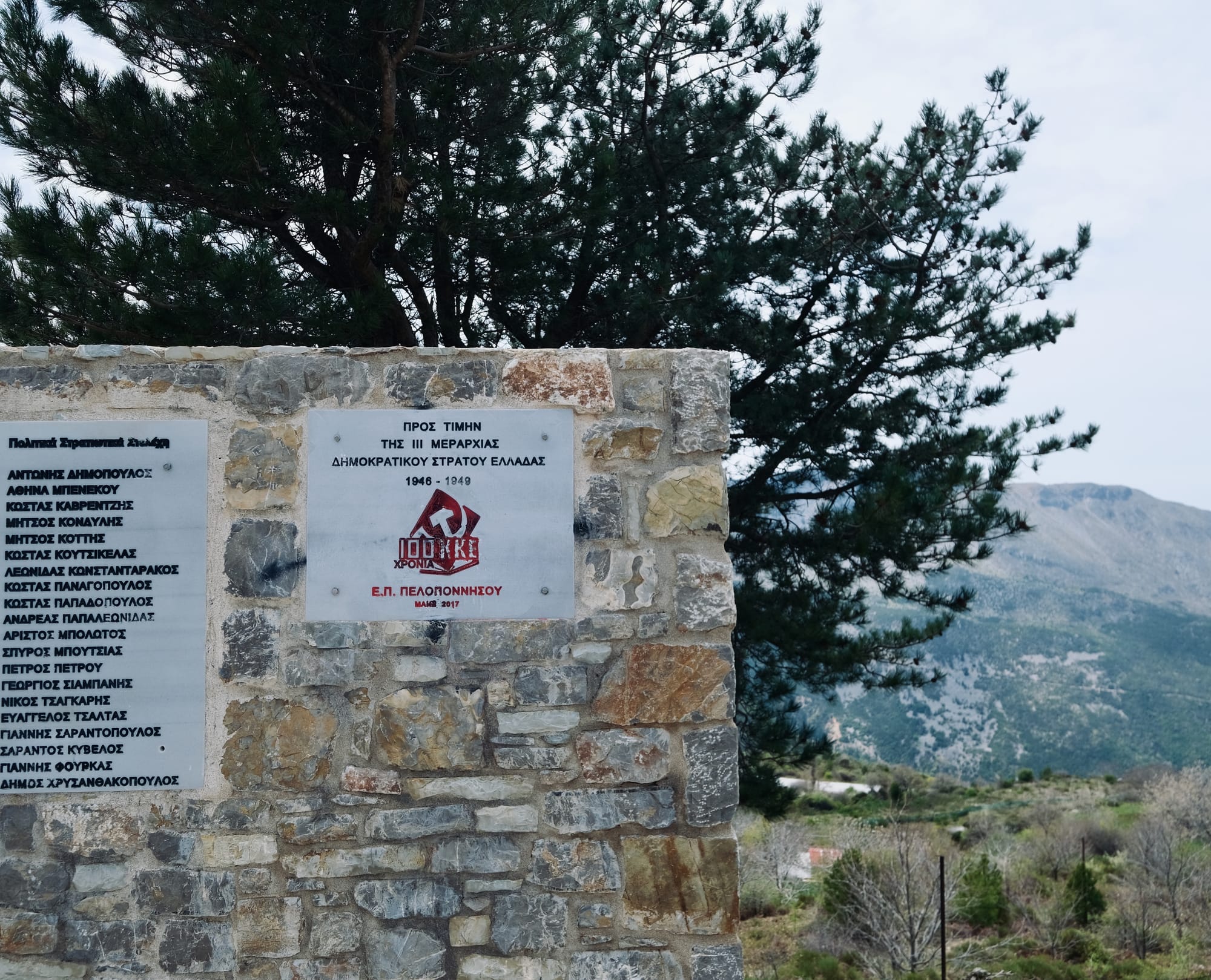
At the highest point of our crossing we pause to take in the view, swap drivers. At the place we stop (between the 32 and 33 km markers on the EO82, at 1500m of elevation) there is a memorial to the third division of the communist forces which fought in the civil war rumbling over the mountains hereabouts between 1946 and 1949. The communist army (the Democratic Army of Greece) was eventually defeated. Revolution is always defeated, or just spent in the vastness of populations and time. The outward exploration of possible other states (something better, fresher, fairer, richer) collapses back to a stone palace, a grim holding on among the wine and rugs and oil and slaves.
...
Telemachus is in search of news of his father, not because of the man his father is – he has never met him – but because of the structural stability his father implies. The house and the House are in disarray. He himself can go nowhere, be no one, unless some sort of structural order is restored. Hence his journey, threading palaces, linking nodes of information.
His chariot ride over the back of the Taygetus mountains has nothing and everything to do with return.
We are accustomed to fixing the structural chaos of the camp – the hunger, the gnawing worry, the gradual dissolution of the physical world – by an outward movement. An exploration. What we call hunting or gathering, or working, or whatever it is that takes us out, is really just a neurotic search for the thing that will fix us.
Our entire psychic sense of the world we inhabit is founded on this anxious pattern of departure and return. Exploration is not an expression of wild freedom. It is a patterned activity. What might begin with a random outward movement becomes systematised, repeated. We explore the wild unknown, perhaps, but we explore in known ways. Groups will cycle between, for example, concentrated winter camps and dispersed summer camps; individuals or sub-groups will go off to check snare traps, fishing spots, observation points; others might busy themselves at storage and drying sites; eventually perhaps, spiritual sites will develop where the tribe or group will gather at certain times of the year and undertake arcane rituals, sacrifice hecatombs, all meant to perpetuate the patterns. The patterns will drift, over time, but persist.
And if there is a pattern to our exploration, so there is a pattern to our remaining in place. We walk desire lines into the fabric of our days. Everything – going out, or remaining – snaps back to the pattern, sooner or later.
However. In between, as for Sisyphus following the rock back down the hill, there is a gratuitous moment. The search becomes a slightly unexpected, jolting twisting journey in the company of your son and brother, and that journey, between the third and the fourth book, say, becomes an unlikely stringing together of some of the happy accidents of existence.
...
Eventually, Telemachus and Pisistratus must come back to earth. Sparta, the Sparta of Menelaus is their destination.
How do the translators describe it? Fagles has it ‘ringed by hills’; ‘land of caves and valleys’, says Wilson; Elijah Fenton, standing in for, and rather brilliantly aping, Alexander Pope, has ‘Sparta, whose walls a range of hills surround’, and Chapman, more mysteriously, has ‘Lacedæmon now, the nurse of whales…’ (not really that mysterious, in fact – κητώεσσα, the Homeric epithet for Sparta, might be translated either 'of whales' or 'with caverns, hollow places, ravines'; Chapman has gone with his briny heart).
We do not see any whales, but we do look down on Sparta from the range of hills.
The journey from Pylos to Sparta takes Telemachus, charioted, just a few lines in the Odyssey; the two-days dust and sweat and aching limbs of it are swallowed up between the end of Book III and the beginning of Book IV.
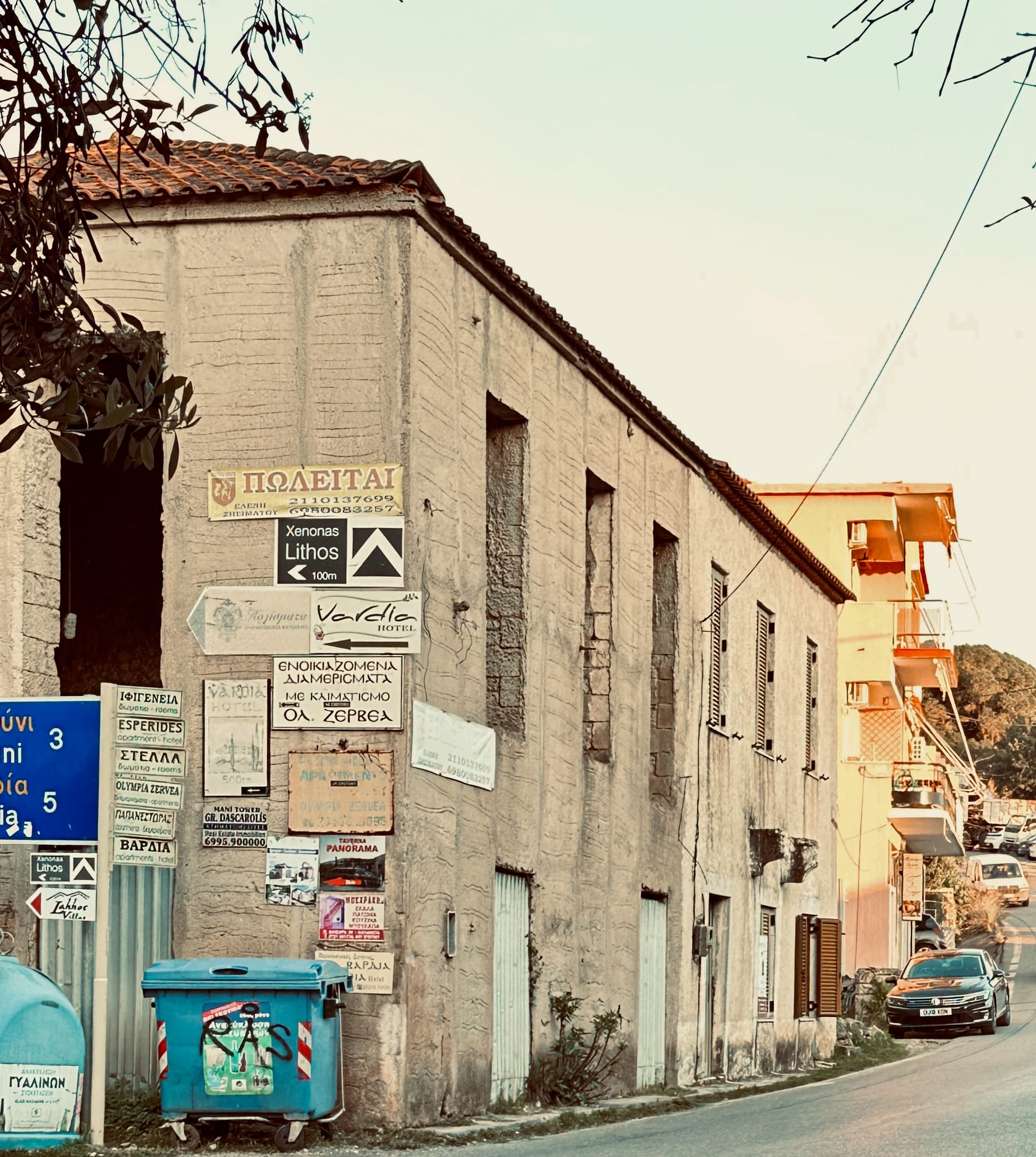
Our journey takes us a couple of hours. It is not really a gratuity, it is a segment of a schedule; but the schedule, insofar as we adhere to it, is really nothing more than a description of a wider journey which is a gratuity. Our drive to Greece and back is a pure romp off the maps of our lives. Each day we fly up on to the chariot boards of our improbable chariot (a dark-grey hybrid-electric VW Passat whose epithet is the Passatoble, because it is a Passat, and I am a Toble); we whip up its 227 horses, ride in delight, and happily not smoking, over mountain passes and the broad plain. Through olive groves.
At some point, we will reengage with our sharper purpose. Our brows will furrow to our work. We will collect the information we came for, build some plan accordingly. But perhaps this was what it was all about, anyway, this forgotten sliver of an itinerary, a getting from there to there. In the epic of our lives, it would merit only a couple of lines. But such lines.
Member discussion