Oxbow
The coasts from a distance are like clouds, where each observer sees the form of the objects that occupy his imagination. Our readings on the chronometer contradicted our maps, and we were lost in useless conjectures. Some took dunes for Indian huts, and pointed out the place where the fort of Pampatar was situated; others saw herds of goats common in the dry valleys of Saint John; or the high mountains of Macanao, partly hidden by clouds.
Alexander von Humboldt Personal Narrative of a Journey to the Equinoctial Regions of the New Continent (1814-25)
The filmmaker Werner Herzog has a saying which many years ago he chose to share with Bruce Chatwin: ‘The world reveals itself to those who travel on foot’. To walk, to move slowly over a landscape, is to perceive both the detail and the deep formation of that landscape.
Herzog was, I suppose, aware of the contradictions and exceptions embedded in his aphorism, as in all proper aphorisms. For instance, the world reveals itself also to those who sit down and wait patiently. Shy creature emerge from the undergrowth, go about their business, undisturbed by your not tramping through their world in your size-12 Salomons.
And the world equally reveals itself to those who roar over it at ten thousand metres. In the Nazca desert of southern Peru at some point between 500BCE and 500CE, people made signs or maps or images which had to wait for the arrival of Peruvian aviators in the 1920s and 30s to be made legible to any but the gods (or the extraterrestrials who created them as landing strips).

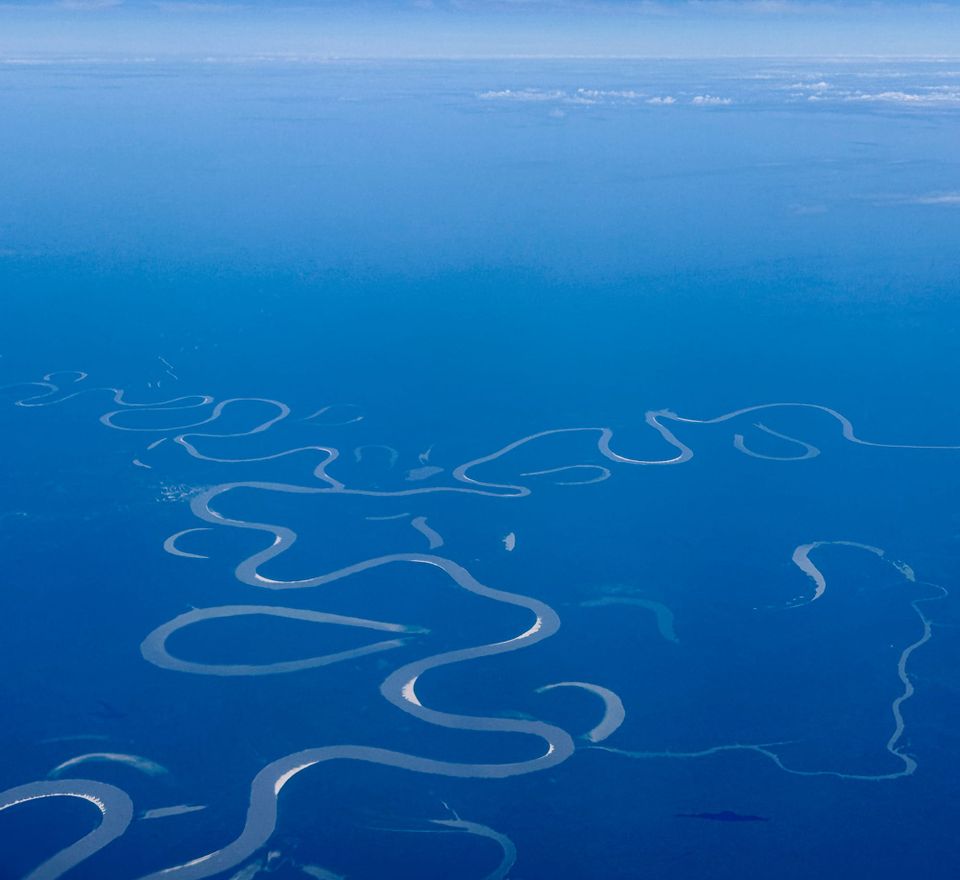
So, too, the Amazon. Fly down, for instance, from Bogota to Buenos Aires, and Amazonia reveals itself to you like a geography lesson.
Takes those oxbow lakes. The forest itself is nothing, just a dull green expanse. You can make out no gradient, no uplands or lowlands. Is that limpid cloud forest you are looking at, or thick matted swamp? Impossible to say.
But those rivers. An untrammelled river cavorts over its landscape, carves it out as the whims and turbulences of flow dictate. There is the main channel, and there are the letters and runes and signs and diacriticals of the oxbow lakes, silting up, immense, slow. A missive from the river gods to the sky gods.
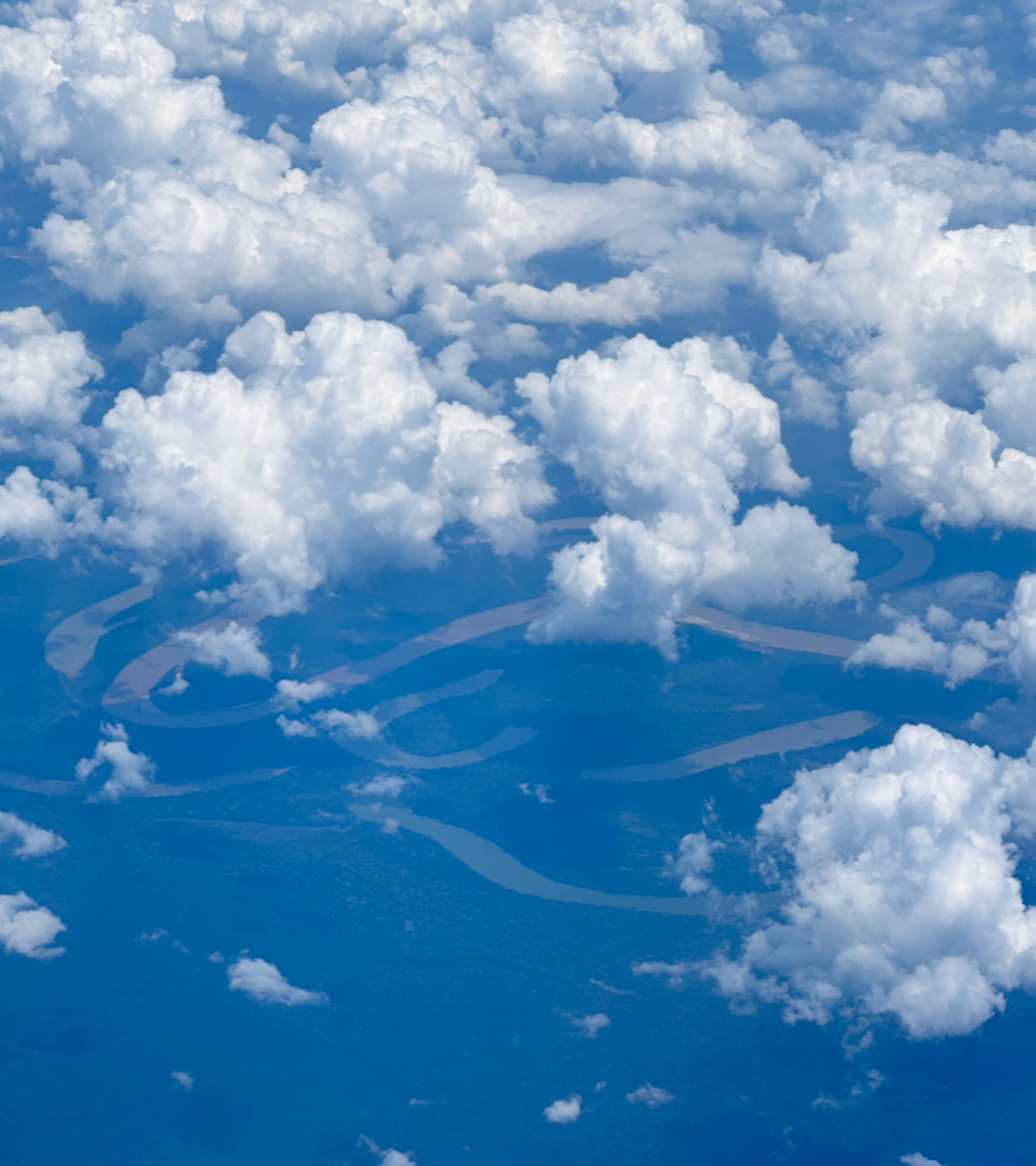
We know how these lakes are formed of course. We learnt it at school, in a classroom in Hertfordshire, say, on a dull winter’s afternoon when the clocks had gone back and it was dark outside. Mr Blake dictated and wrote longhand on the board, and we copied it down. Oxbow lakes formation of. Perhaps he drew some diagrams. I doubt we looked at photographs, but I suppose we may have.
And I have seen oxbow lakes elsewhere. But they were puddles. These are whole landscapes. Humboldt and Bompland must have know multitudes of them, as they made their way up the Orinoco and Casiquiare, may well have know from their ‘O’-Level geography how they had formed. But perhaps not. Perhaps they only encountered expanses of riverine marsh and swamp. Cursed their slow progress around and over them.
Werner Herzog, also, cursed the slowness of the jungle, when he was making the movie Fitzcarraldo (1982), in which a Peruvian rubber baron, played by the unhinged Klaus Kinsky, attempts to have a steamship hauled through the rainforests, so that he can unlock rubber production and build an opera house. Stuck week after week in the Amazon with a deranged lead, a disgruntled, sick crew, jittery and often violent indigenous tribes being used as extras (who at one point offered graciously to kill Kinsky for Herzog), dwindling budget, and a great stupid ship, Herzog saw only the rotting compost of his own psyche reflected back at him.
The perspectives of the jungle, seen close to or from up here, are rather distinct. Up here, the flight crew bring us our meals, and we start to finick around with our miniaturized, standardised breakfasts, the little plastic cutlery sets, the laboratory-clean shrink-wrapped rolls with their cold, hard little pats of butter, the compacted omelettes, the black coffee. All done in a few efficient minutes, not an iota of biomatter out of place.
We glance out of the window from time to time, at the great roiling rivers.
...
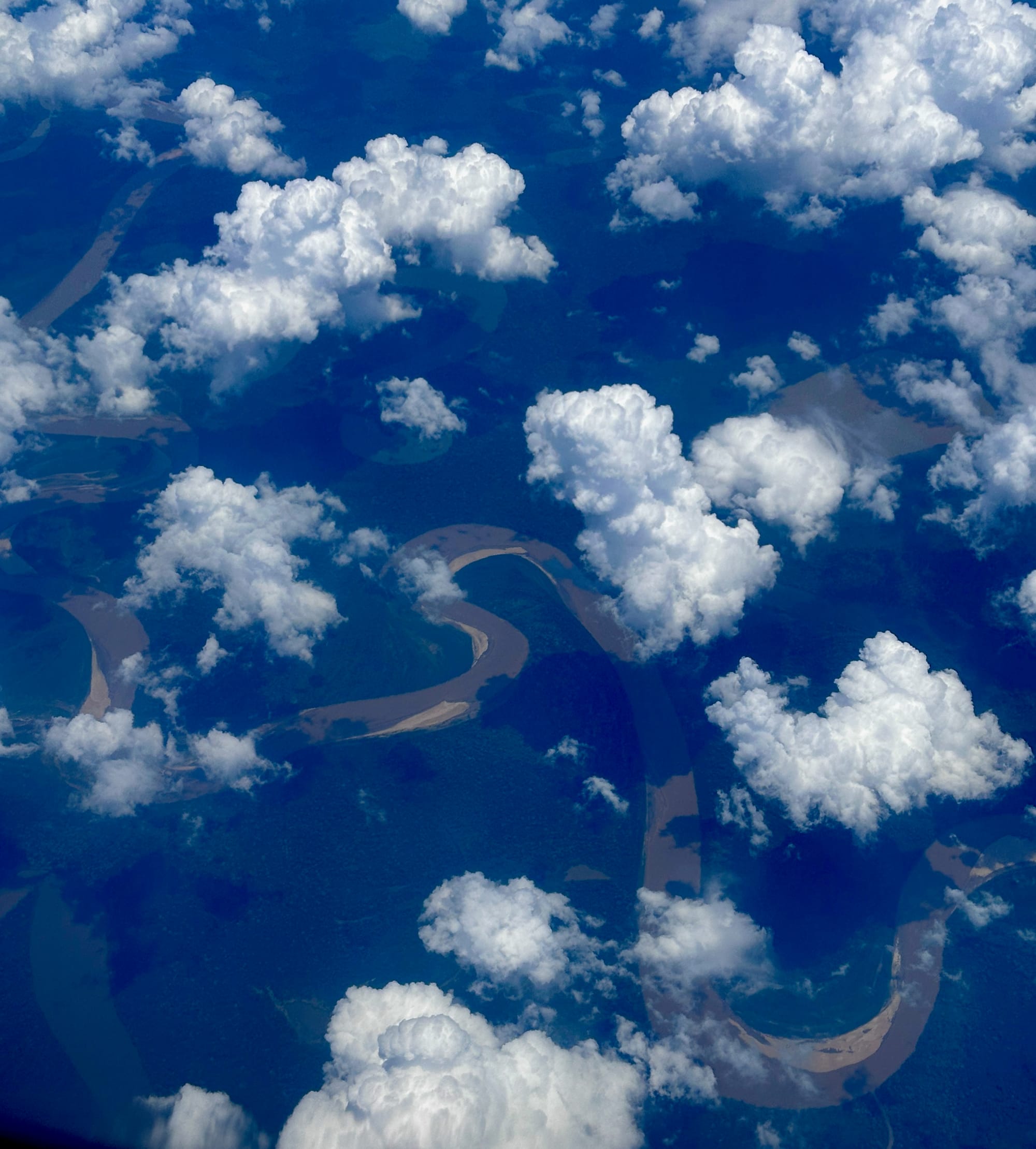
Breakfast done, I snap photographs from the window and nudge my brother and point down at the great brown silting rivers below. We marvel at their immense work, and speculate about their identity, their unknowability. They are just so many great brown silting vectors of force, lost in an even greater immensity of resistance.
But that sense of supreme unknowability is fugitive, and false. There is always a locale, a place, a name, depending on your perspective. When I get home from South America, I realise that a couple of the photographs I took from the plane were miraculously geostamped, and I could in fact accurately identify the rivers below. This, for instance, is the Amazon the island Isla Santa Rosa, and the two settlements you can just make out in the bottom of the frame Leticia in Colombia and Tabatinga in Brazil; this is the point at which the borders of Peru, Colombia and Brazil converge.
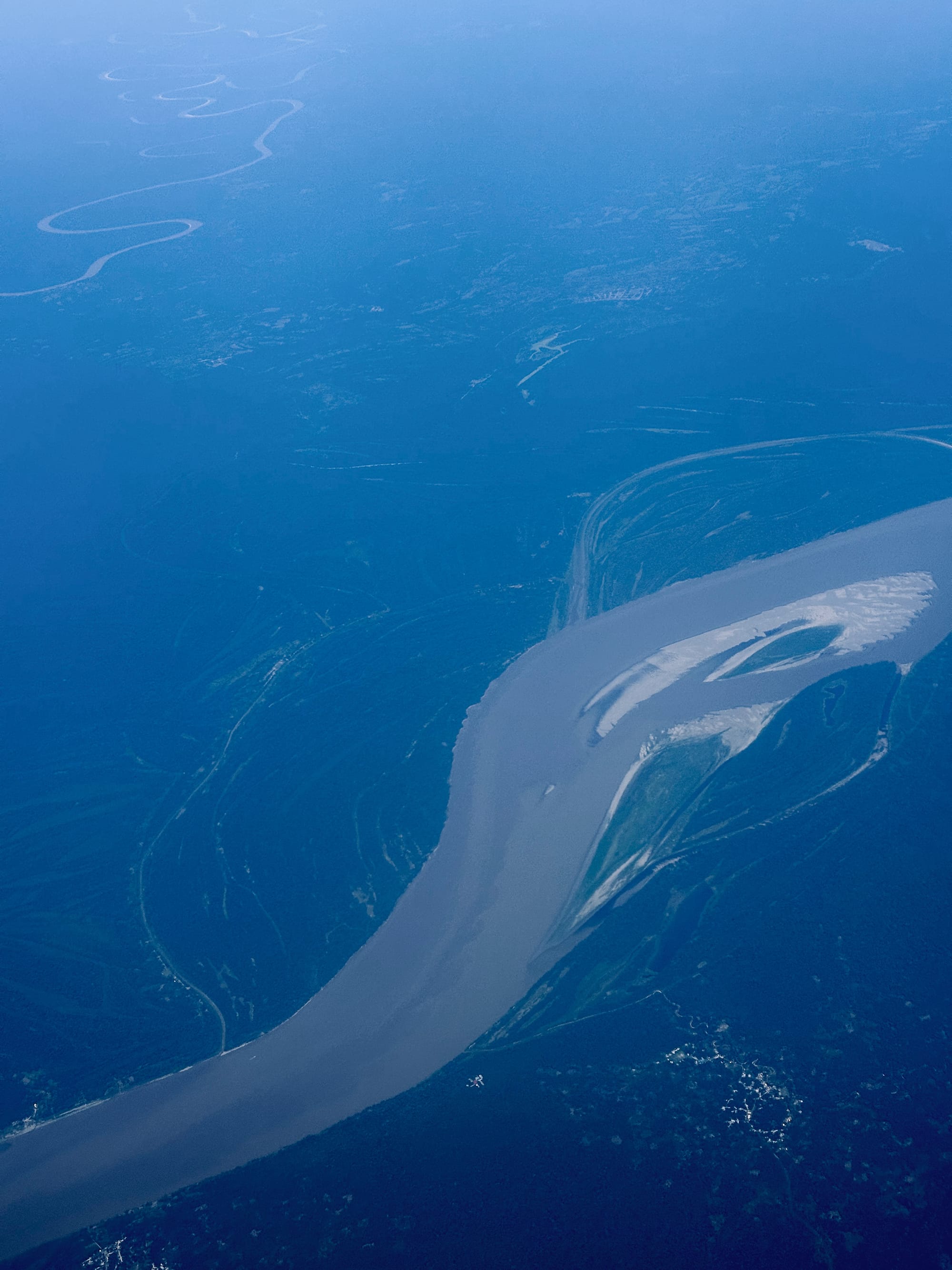
I can, if I wish, (and I do) open Google Maps and zoom in, peruse the photographs of others who have walked these streets in this immense landscape, look into the faces of the people who live down there. What was for me, in my 10,000-metre exultation, a vast spiritual unknowableness, resolves itself to a sufficient level of detail, the knowable human-scale. Down there, it turns out, lies the usual bucket of middle-sized things in a bounded and traversable volume of known space. A useful degree of precision lies to hand, if you want it. Had Herzog chosen to botanise, rather than drag a steamship about and curse his own luck, perhaps the jungle would have revealed itself differently to him, a proliferation of nameable, knowable things.
Member discussion