Psychomachia
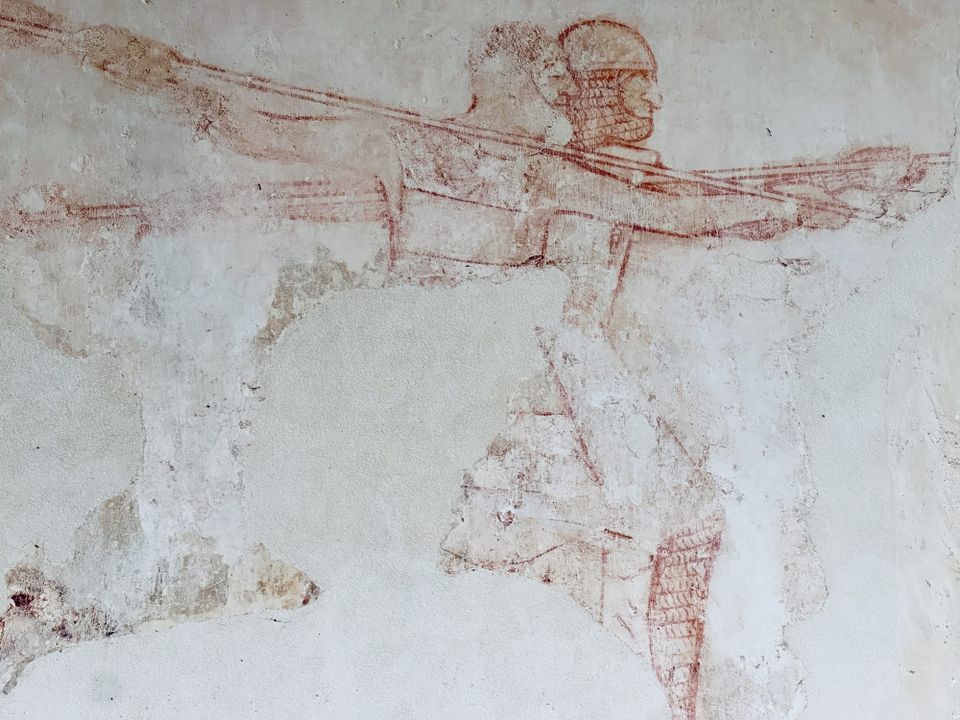
My family and I take a walk in early spring over the gently, very gently, rolling uplands of west Cambridgeshire, from Wimpole back towards Cambridge through the village of Kingston (population: 238 in the 2011 census, up from 115 in 1086) where, in the parish church of All Saints and St. Andrew, we stop to look at the scraps of late-thirteenth-century fresco they have there. Notable among them is a depiction on the north wall of two mailed soldiers busy at their work. They are usually taken to be what is left of a psychomachia, a representation of the struggle in the soul between the virtues and the vices.
The Psychomachia of Prudentius (348AD-after 405AD) was one of the great allegorical poems of the early Christian Middle Ages. It evidently appealed to the disposition of the medieval and more broadly Christian mind for binaries, according to which we are all either elect or reprobate, saved or damned, sheep or goats. Thus our souls were a battleground where daily and nightly the forces of purity waged war with the forces of dark impurity. It is always the same old tale, the eternal struggle of Roundhead and Cavalier, of the stripped and severely functional Classical, and the exuberant proliferation or (depending on your taste) excrescence of the non-Classical, whether Gothic, Baroque, Rococo, Romantic, or whatever. The pendulum is always swinging.
We still have respect this opposition of virtue and vice, whether we know it or not; we do not so much represent it to ourselves nowadays as purity and sin so much as a struggle between discipline and technology, between our souls and our phones, between the healthy, early-morning regimen designed to fortify cognitive resource and the looser, more corrupting habits of inattention. To be fully human, we learn, is to wander free over the fields without your phone (we all four have our phones on us, needless to say); to pay deep attention to the world unfolding around you; even though, at some deeper level we all know very well that to be fully human is really to seek opportunities to pay lavish inattention, to idle, to play, joke, not because these modes amplify our cognitive resource, but specifically because they do not deplete whatever little of it we have remaining. Thus I do not write by hand (which I mostly do, in toffee-brown ink, as it happens) because it is a species of admirable mental gymnastics, but because it gives me the same sort of mild bodily pleasure as, I imagine (but also full well know) the anonymous and itinerant artist of the Kingston psychomachia derived from drawing his paint-laden brush smoothly over the dry plaster (the fresco was painted secco, or dry, not di buon fresco), ruling the line of the lance, or improvising freehand the line of the nose.
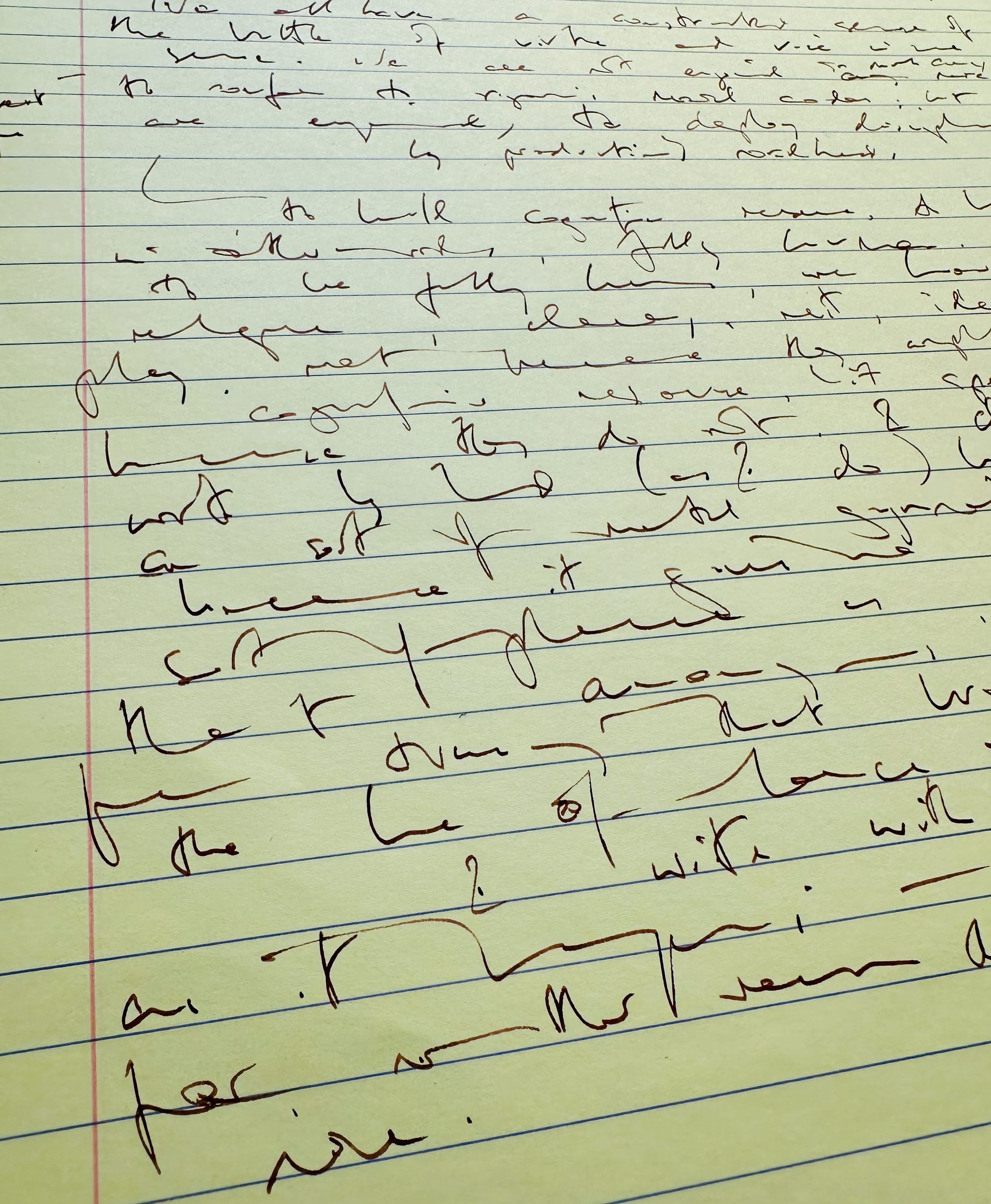
In short, we all always torn to some degree between an appreciation of the so-called simple pleasures (walking over the fields, spending unstructured time with loved-ones, writing with brown ink on a yellow page) and a suspicion that there might be more elusive, or precious, or frankly more humanly complex pleasures to be had from life. More wrought, more Saturnalian, experiences. Somewhere beyond those simple horizons.
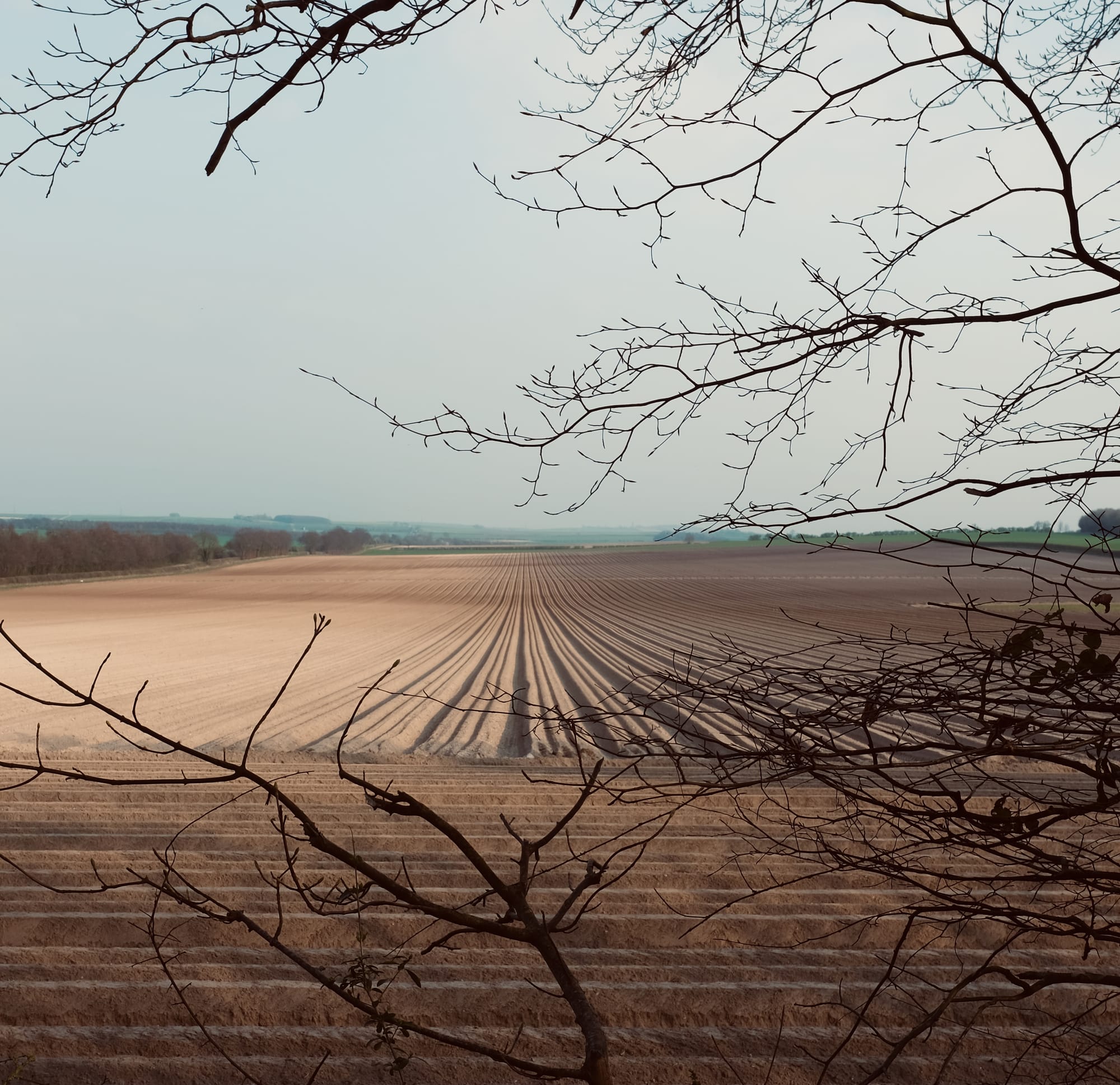
Still, as simpler experiences go, there is not much to top an early spring walk on a blowy, sunny day, over the south-Cambridgeshire fields with your family, a few picnic items in the bag. It is a walk with a sort of a route, not really with a destination. Kingston Church is, in our free-flowing scrawl of a walk, an interpunct only, a semi-colon of a place allowing us to catch breath, sit down for a moment but not quite settle in, adjust our eyes away from horizon-scope, focus on something different from the wide fields.
D.H. Lawrence, in Sea in Sardinia (1921) remarks on the pleasure of not having to visit sights.
There is nothing to see in Nuoro: which, to tell the truth, is always a relief. Sights are an irritating bore. Thank heaven there isn’t a bit of Perugino or anything Pisan in the place: that I know of. Happy is the town that has nothing to show. What a lot of stunts and affectations it saves! Life is then life, not a museum-stuffing. One could saunter along the rather inert, narrow, Monday-morning street, and see the women having a bit of a gossip, and see an old crone with a basket of bread on her head, and see the unwilling ones hanging back from work, and the whole current of industry disinclined to flow. Life is life and things are things. I am sick of gaping at things, even Peruginos. I have had my thrills from Carpaccio and Botticelli. But now I’ve had enough. But I can always look at an old, grey-bearded peasant in his earthy white drawers and his black waist-frill, wearing no coat or over-garment, but just crooking along beside his little ox-wagon. I am sick of “things,” even Perugino.
Well then. I wouldn’t presume to disagree. I remarked as much to my brother walking down some deep-frozen residential street of Hamburg just a few weeks prior, how pleasing it is just to watch Hamburg people going about their (to them) dull Hamburg business, walking dogs and getting on buses. Although, come to think of it, we were at that moment walking to the art gallery.
But here in Kingston, I would observe, there is no one to watch. We do not see a solitary person, except for the driver of the No.18 bus which rattles though as we exit the churchyard, the bus as wide as the lane that Pevsner simply calls 'the village street'; the driver gives us a professional wave as we stand back. Out here, any human presence is remarked. And so the only ‘life’ to be had, apart from our own, is the life of the brown painted figures of the church. They are generic, the figures, allegorical; but also strongly individuated, historically specific – mark the lines of the noses, the variation in expression from complacent, beatific even, to intent, the detail of armour (the mail coif of the soldier on the right, notes Pamela Tudor-Craig in her essay, 'Wall Paintings' in Cambridgeshire Churches (1997 ed. Hicks) was no longer used after around 1250). These are, in their detail, their individuation, their localisation, people. This is, for want of a better word, life. An odd quiet revelation of human particulars.
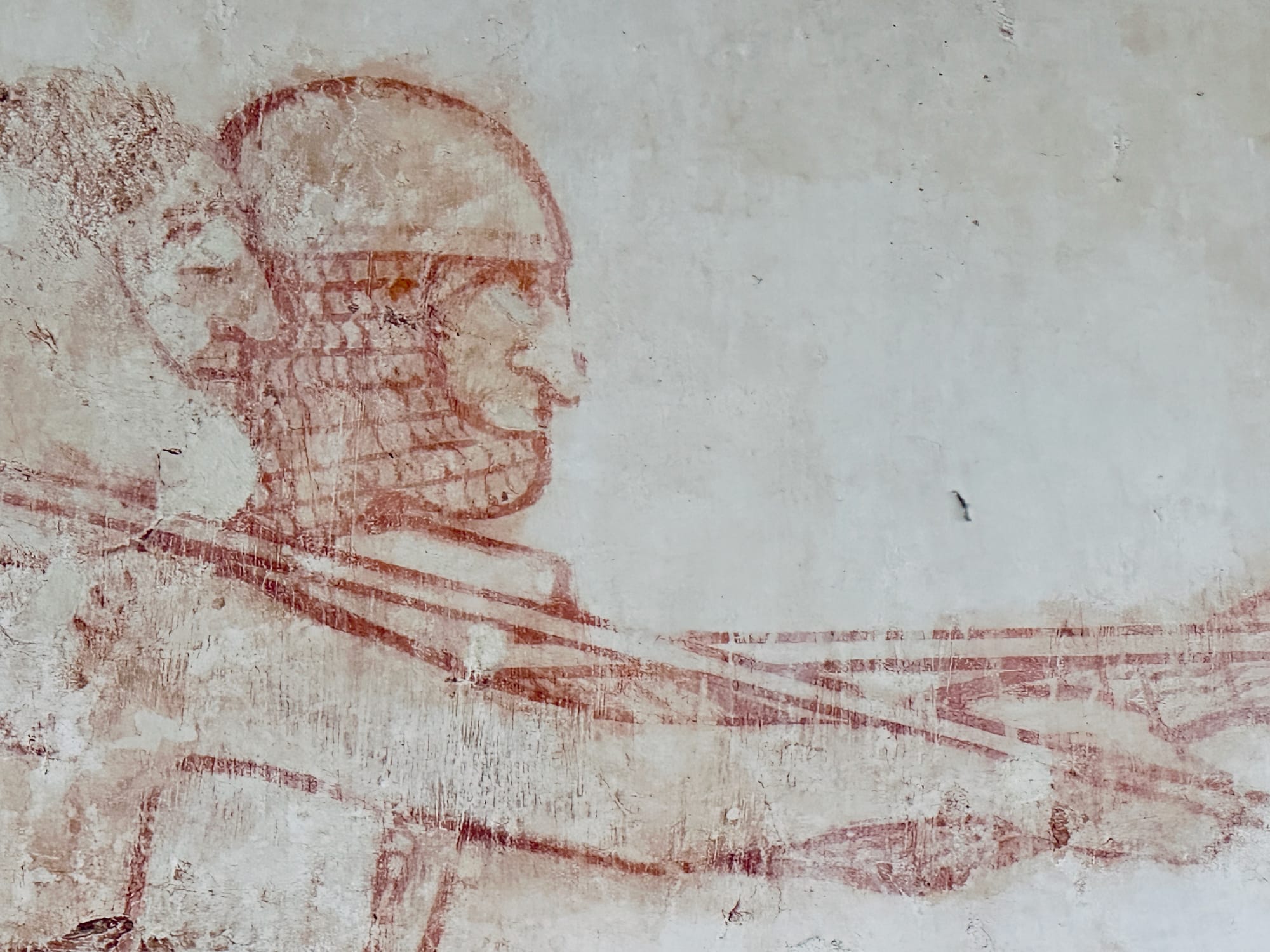
The paintings were covered up at some point in the church’s history, which saved them from the later attention of frothing iconoclasts. Classicising roundheads. They were uncovered probably in the late nineteenth century, preserved (actually, rather badly damaged) under wax in the early years of the twentieth, then restored in the 1980s. And so here they still are, the work now of many hands, an ongoing flicker of life in the always pleasingly haphazard, non-museum-stuffing of local life, which is an English parish church.
We disperse around the tiny church, looking at this or that detail; I read aloud for everyone’s improvement from the Pevsner I have brought along (the sort of book Lawrence would gaily have thrown from the window of his Sardinian bus). The text is laden with chancels and lancets and clerestories and transoms; Pevsner directs our attention to features which are single-chamfered or semi-polygonal or unbuttressed or super-ordinate, or which have crocketed cusped gables or middle mullions; and so they go past in a blur of clerical drone, like some dreary but (I trust) comforting sermon. And then one of my sons notices a drowsy hornet crawling on a radiator. I have sent him to sleep with my middle mullions. But I do not love hornets, drowsy or otherwise, and to remain in the church is for me now a ticking, minor anxiety; and anyway it is sunny outside, and we have crisps. So our visit is done.
A little later, as we make our way over one particularly blowy hillside with, by Cambridgeshire standards, near-Alpine views across the landscape, my younger son remarks that you wouldn't imagine we were only a few miles from home. He is feeling the pull of distance, I infer; but he is right. We are, in a sense, dislodged, and a long way from anywhere familiar.
When I was eighteen or so (as my sons are now), a walk like this would have had folded within it a deep double excitement: of, on the one hand, the simple elements of the here-and-now (sun, wind, a leg-stretching walk); and on the other of the possibility buried within it: possibility of manifold horizons, of the out-there, the beyond, the place not yet known or established, in which I would finally and fully begin to realise myself.
That excitement is still buried in me, and perhaps in everyone else, never far below the surface. We are forever, in spirit if not in fact, moving between camps. And a fresh camp, if nothing else, is always a fresh beginning, never quite the same as the last time we passed this way.
Like all long walks, ours starts as a gambol and ends as a trudge. But in the unfolding of detail and the unrolling of the wide canvas of the landscape as we make our millennial progress over the ancient, slowly evolving fields, there is the potential, if not for an actual psychomachia, then at least for noticing the beat of the lifelong irresolvable dialectic between the opposing poles of go and stay; from which oscillation an actual life in time will grow.
Member discussion