A Note on Polymorphs of the Arctic Char, and the Robes of Christ
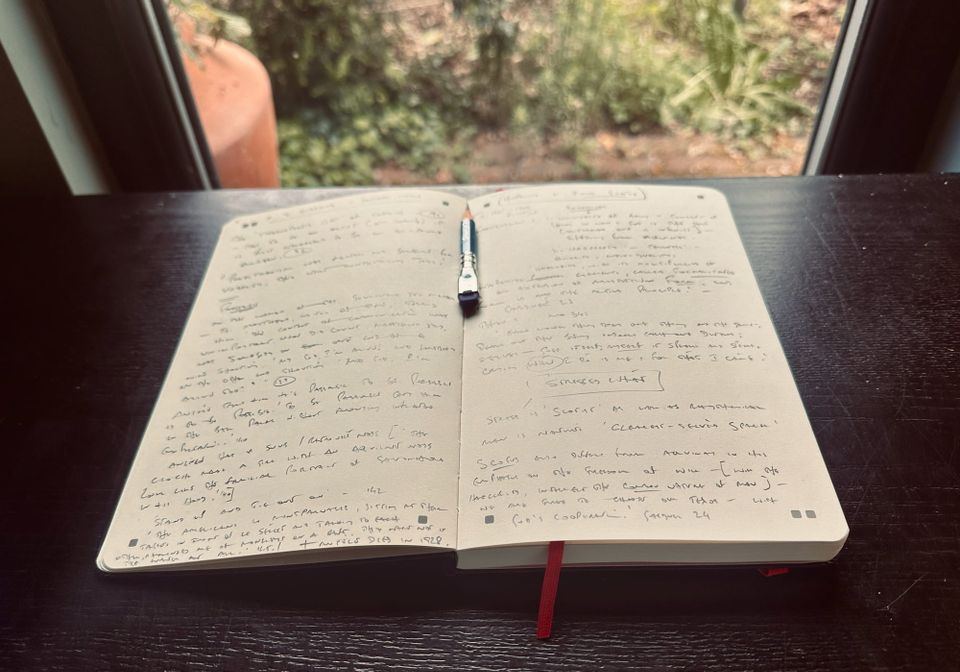
A friend of mine, young enough and free enough never to have heard of Bruce Chatwin, gave me as a present a Moleskin™ notebook and a book (Between Meals, by A.J. Liebling). I promptly read the book, and processed it into a page of notes in the notebook, in an autophagic sort of spirit. Who knows if I will ever bother to read the notes again; nonetheless, the process is the process.
Chatwin, in The Songlines, lamented the demise of his carnets moleskines (le vrai moleskine n’est plus), which he bought in bulk from a papeterie in the Rue de l'Ancienne Comédie in Paris; but here is one on my desk, one of the new incarnations. Slowly I fill its pages, with my little stub of a pencil.
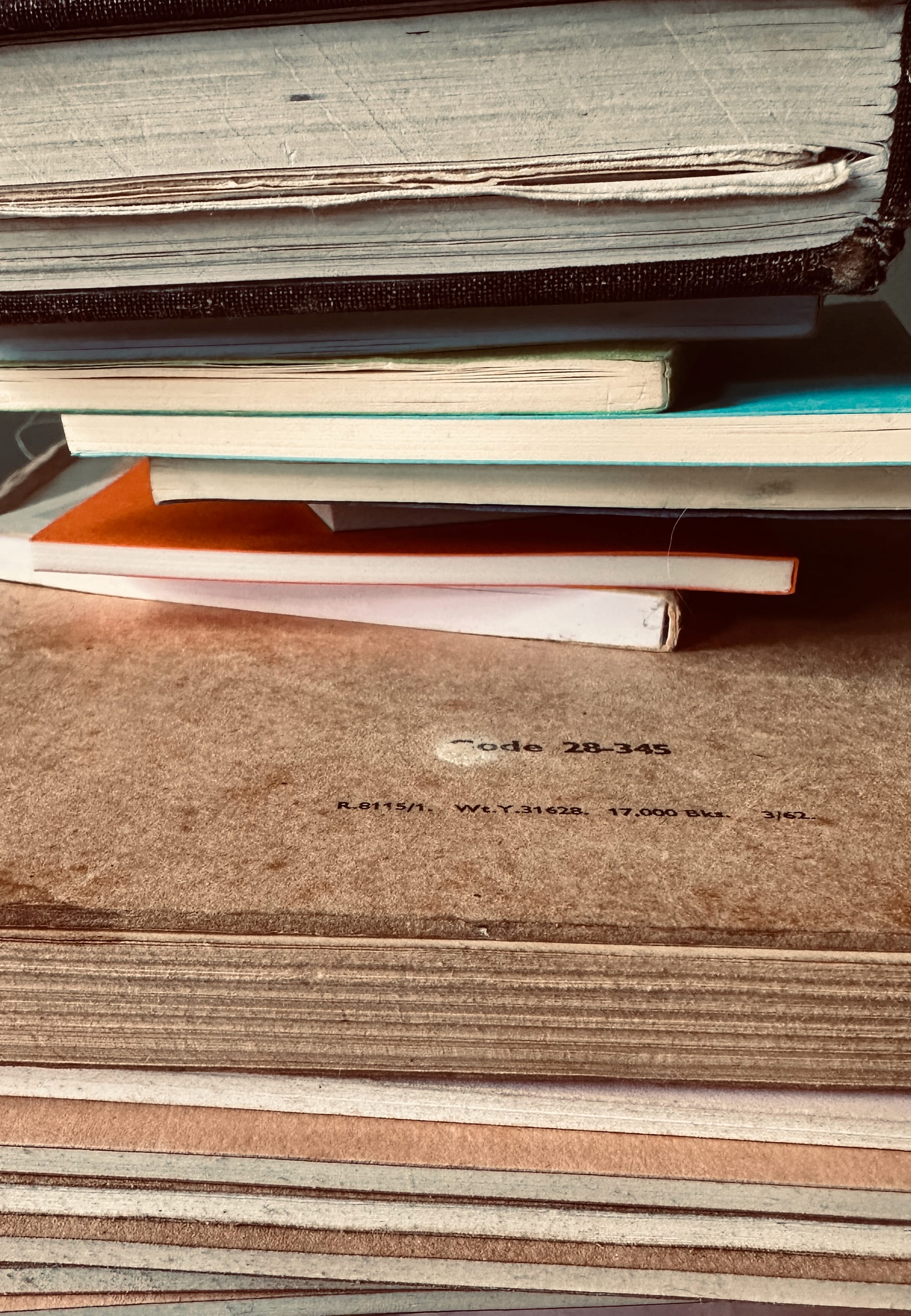
By coincidence, when I received this gift I had in fact been conducting what I fancifully called an audit of my notebooks. I have great irregular discordant piles of them; some are empty, some are dog-eared; some have only a couple of scrappy notes on the first few pages. I always take one with me when I travel, but rarely write in them now; I make fairly extensive notes on what I read, but much of that is in Notion, not on paper.
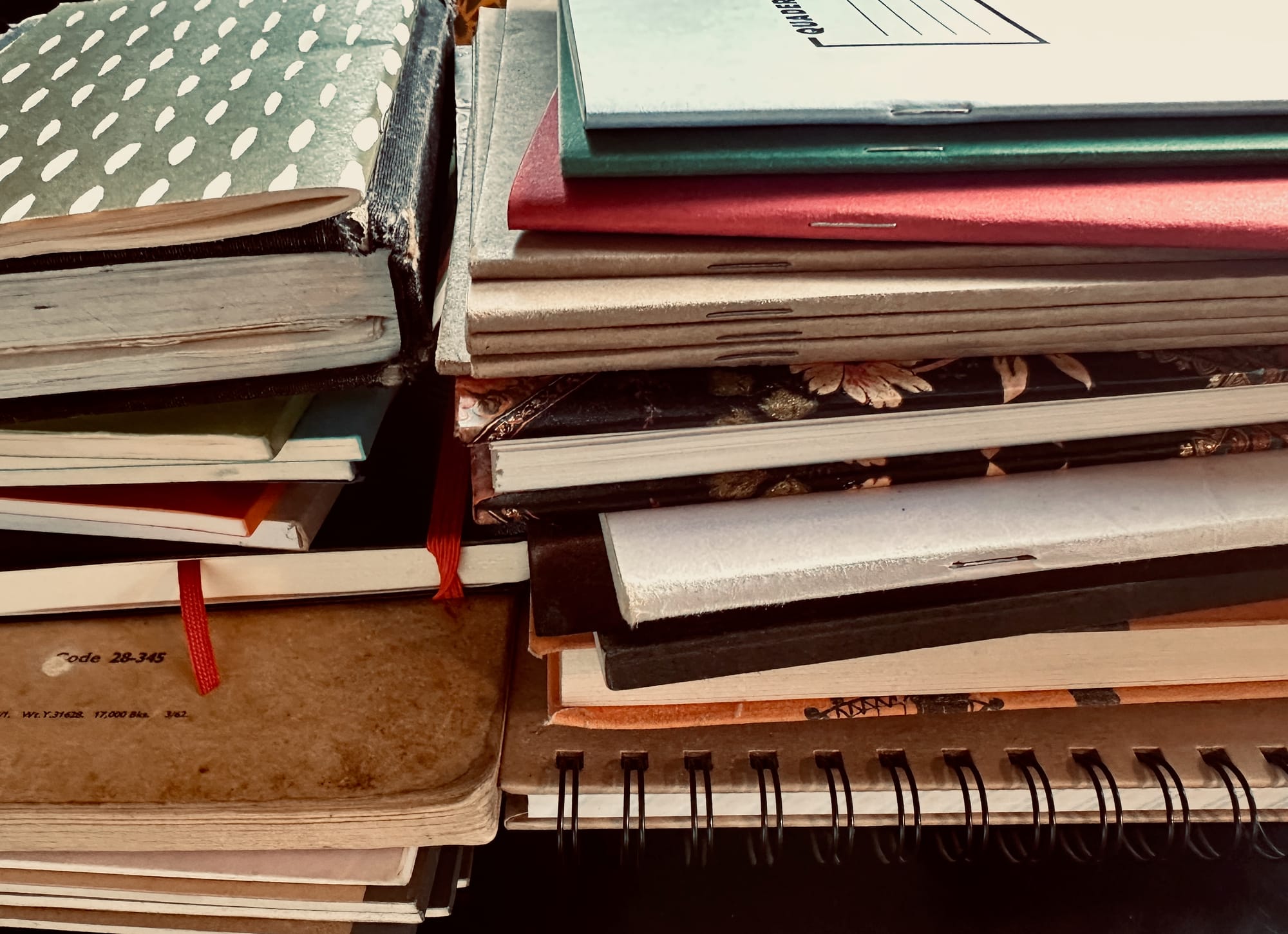
Still, people give me notebooks from time to time, or I buy them on impulse. It is hit-and-miss, however, whether I will ever write in them. There is perhaps a subtle psychology at work here, but I suspect the determining factor is merely practical: this one opens flat; that one requires me to write down into the centre of it like an Alpine skier bouncing down moguls; that one bleeds through; this one has fat opaque paper. And so on.
And there are aesthetic considerations. I am a minor stationery fetishist, and gleefully subscribe to what I know full well to be the stationery fallacy: the erroneous belief that if I could only source the right stationery, the right notebooks, folders, pencils, pens, (increasingly, the right note-taking, project-managing software), I would finally be on my way, making progress on my various hare-brained schemes. Everything would fall into place. I would be compiling, not sheafs of scraps of useless doodles and prison-wall scrawlings, but a neat and functional database.
I know that I am not alone in this. There is a passage in The Songlines where Bruce Chatwin fantasises for us his writing process. He is stranded for ten days by the rains in a tin caravan in a tiny settlement in Central Australia. ‘For lunch we had beer and a salami sandwich’, he writes. ‘The beer made me sleepy, so I slept until four. When I woke, I started rearranging the caravan as a place to work in.
‘There was a plyboard top which pulled out over the second bunk to make a desk. There was even a swivelling office chair. I put my pencils in a tumbler and my Swiss Army knife beside them. I unpacked some exercise pads and, with the obsessive neatness that goes with the beginning of a project, I made three neat stacks of my ‘Paris’ notebooks.’
This is vision of writing all writers will sigh at. The writer removed to the furthest edge of his or her known world, settling down in the midst of a curated clarity to produce, well, The Songlines.
In fact he wrote The Songlines nowhere near Central Australia. He did settle down with his notebooks, in various locations, from Northern India to the Cotswolds, but the bulk of the thinking was done in a self-service apartment in a hotel in Kardamyli on the Mani peninsula, near the home of his friend, the writer Patrick Leigh Fermor. Leigh Fermor later wrote that Bruce had driven down to Kardamyli with, yes, his notebooks, but also with his typewriter (an Olivetti, probably a Lettera 32), a filing cabinet, his scuba-diving equipment and surfboard, his fountain pen filled with ink from Asprey’s, and so on. On one occasion Leigh Fermor arrived to find Chatwin standing in the middle of his room surrounded by sheets of paper he had evidently strewn around (‘like leaves at Valombrosa’, in Leigh Fermor’s words) in a Eureka moment. ‘I know how I am going to write this book’, he said, from the midst of the welter of mess and clutter. We are a long way from neat and numbered piles of carnets moleskines.
Patrick Leigh Fermor had his own trouble with notebooks. At the point where Chatwin arrived to work on The Songlines, Leigh Fermor was putting together the second volume in which he recounted his great walk, aged eighteen, across Europe. Between the Wood and the Water would be published in 1986. He would then spend another twenty five years struggling, and failing, to complete the account. The walk had taken him two years, more or less. The books detailing the walk would take him forty years, and he would fail to complete it. In part, this was down to the loss of some notebooks which had been stolen with his rucksack in Munich, during the walk; but it was more materially down to the finding of another notebook, the so-called Green Notebook, which turned up on a visit to an ex-lover in Romania just as he was starting to put the work together. This Green Notebook, evidently, did not accord with his actual memory of the walk. Now he began to doubt everything. He was undermined. Between memory and notebook, there was an unbridgeable gulf of doubt. Each day he fretted and, in his words, Penelopised, unpicking the previous day’s work. All because he could not make moribund notebook accord with living memory.
Paul Theroux writes somewhere (I think in his book about travelling around the circumference of the Mediterranean) that the notes you take in a notebook when you are travelling are always the wrong notes. You dutifully jot down impressions, details, scraps of conversation; and then when you come to write your book, you find your mind going elsewhere, to the odd, more unstable, more fruitful, reconstructs of memory. The notes you took seem like the notes of another person. Irrelevant to the point of it all.
That might just mean he was a poor notetaker, Chatwin a good one. Chatwin, after all, downloaded and brain-dumped, on the face of it, great raw dollops from his notebooks into The Songlines. It was how he solved his creative impasse. The notes, we are to believe, had been the book all along.
But there are other possible explanations for the disparity between note and life, note and book.
We know, for example, that, crudely, the brain pays two different kinds of attention, corresponding to the two neuronal masses, or hemispheres, or if you like, brains, with which we are gifted. There is the narrow attentional beam of the left brain, with its manipulation of whatever concrete thing lies in front of us (the food-acquiring or food-processing form of attention, in evolutionary terms). And then there is the numinous, peripheral attention of the right-brain, more global awareness than narrow focus. In evolutionary terms, this is the part that keeps us constantly vigilant, looking over our shoulders for possible threat. The left brain traffics in concrete detail and more-or-less conscious observation (treating the world as there and inanimate, in neuroscientist Ian McGilchrist’s formulation); the right brain attends to the ambiguous, the demi-lit, the flicker of movement in the corner of the eye, the fleeting impression. It is this latter form of perception that we want to get at in our writing. The former is what makes it into our notebooks. Our notebooks, in this light, are so much carcass, detritus, offcut. We long since ingested the meat. It is part of us now, flickering there somewhere internally. Bothering us.
To repeat, my own travel notebooks (I only dignify them with the term for convenience sake) are worse than useless. I fill them with dull observation and half-ideas and banalities and illegibilities, and then give up a few pages in. Two days of a given trip will emerge from the pages of a notebook in a scatter of banal detail; and then I will be forced to fall back on a patchwork of photographic record and probably false memory, like trying to reconstruct the Odyssey from a shoebox of fragments of Oxyrhynchus papyri and some folk memory of the tale.
In Greenland, for instance, I took what must have seemed at the time important notes on what some Norwegian scientists I got talking to told me about polymorphs of the Arctic char, object of their field-study, and failed to mention the glacier I got talking to them in the vicinity of. But then, what do you say about a glacier in a little green notebook?
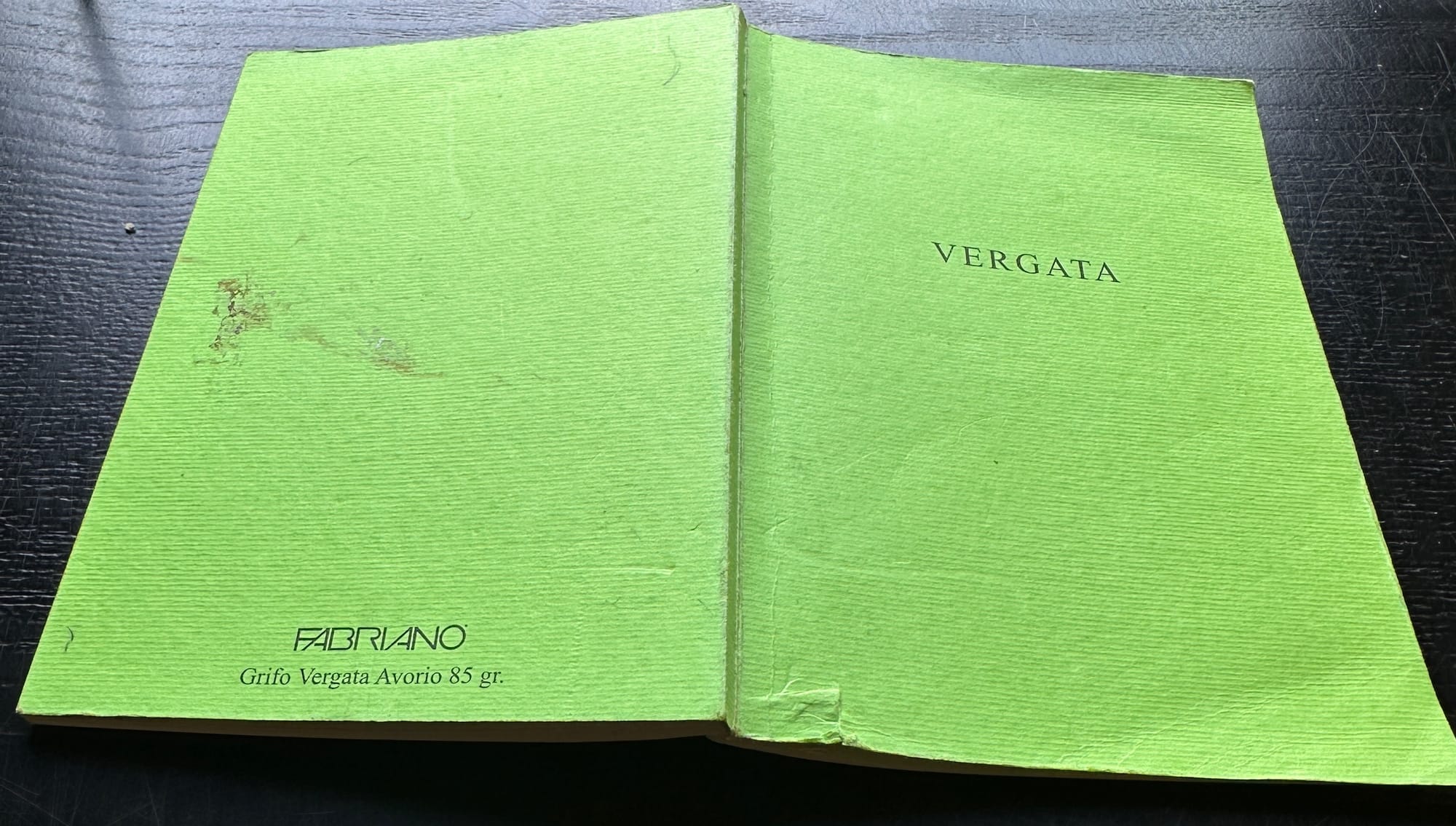
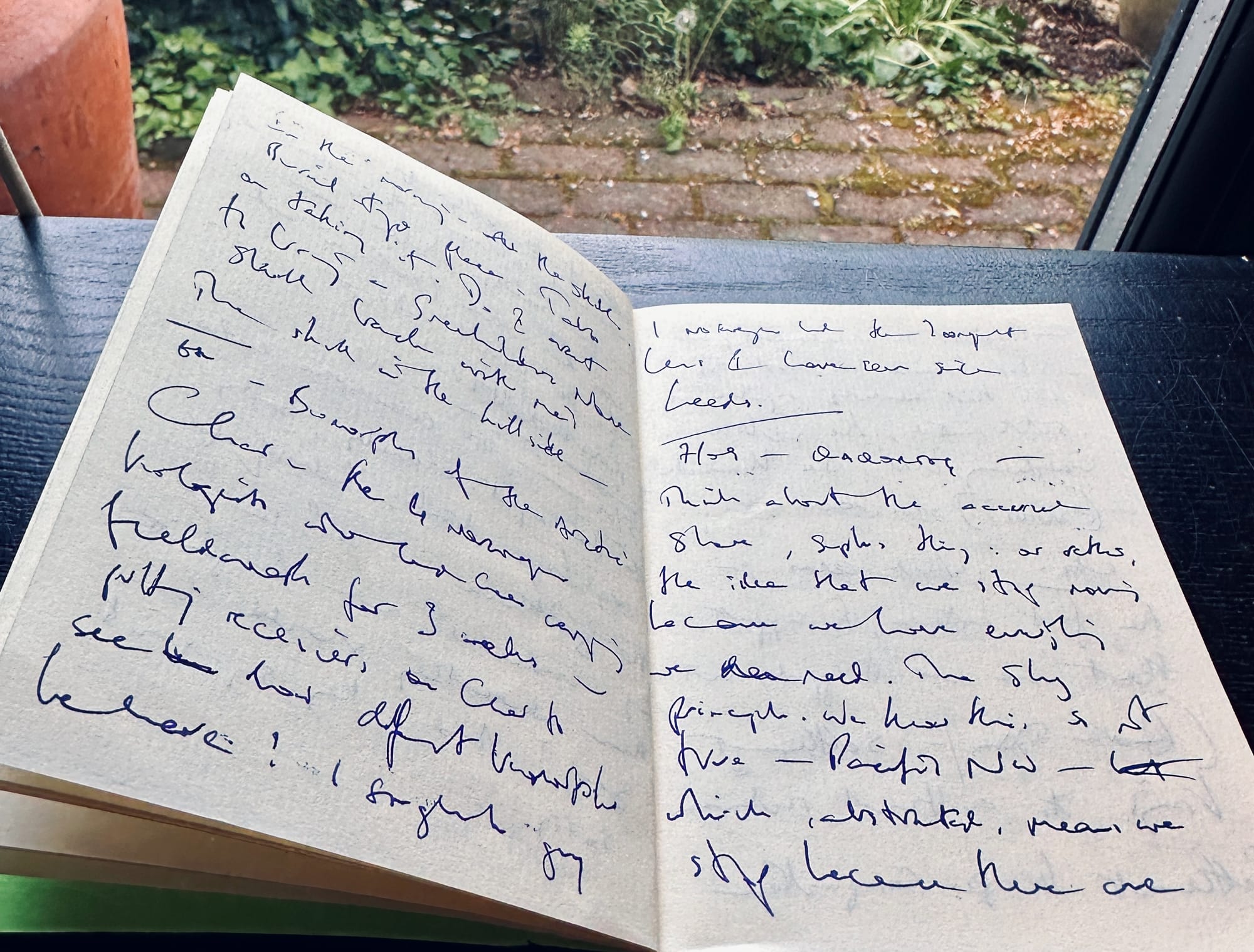


But there it is. Your notebooks are not supposed to be a body of work. They might be no better than a sump for distracting thoughts: you do not write notes of things you want to remember, but of things you are keen to forget. To jot something down is to prepare to leave it behind.
The very last words Bruce Chatwin ever committed to a notebook, shortly before he died of AIDS at the age of forty-nine, were ‘Christ wore a seamless robe’. There he breaks off.
Or perhaps not. Perhaps it is at this point that the imperfect, unsatisfying, but living, ongoing notebooks hand over to the the great marbled sepulchre of the Books. A book, from a certain perspective, is a seamless robe; the notebooks are so much loose thread and offcut; they are misspelt, inaccurate, ungrammatical, polymorphic; all exposed seam, so to speak.
That last line, then, is a casting off. Into the seamlessness of death and the printed word.
Member discussion