Jeremiah
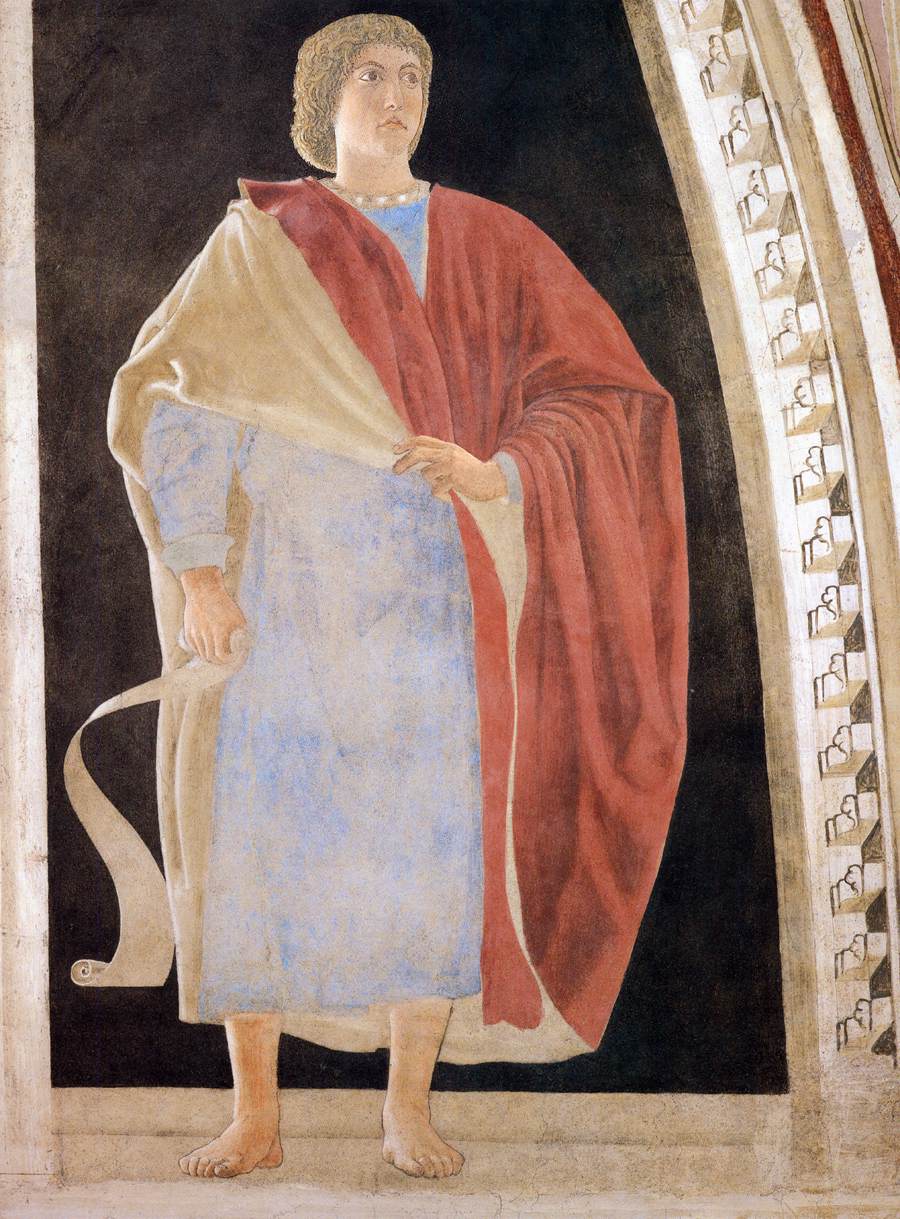
Why gaddest thou about so much to change thy way?
Jeremiah 2:36
In late December 1990 I bought a radio, a charcoal-grey Sony FM / AM receiver, the size of a fat hardback book.
I was twenty, in my last year at university. I put the radio on my desk, which occupied the whole of one end of my narrow college room, thinking I would listen to music as I studied. But soon after, they launched Operation Desert Storm, and I listened to that instead.
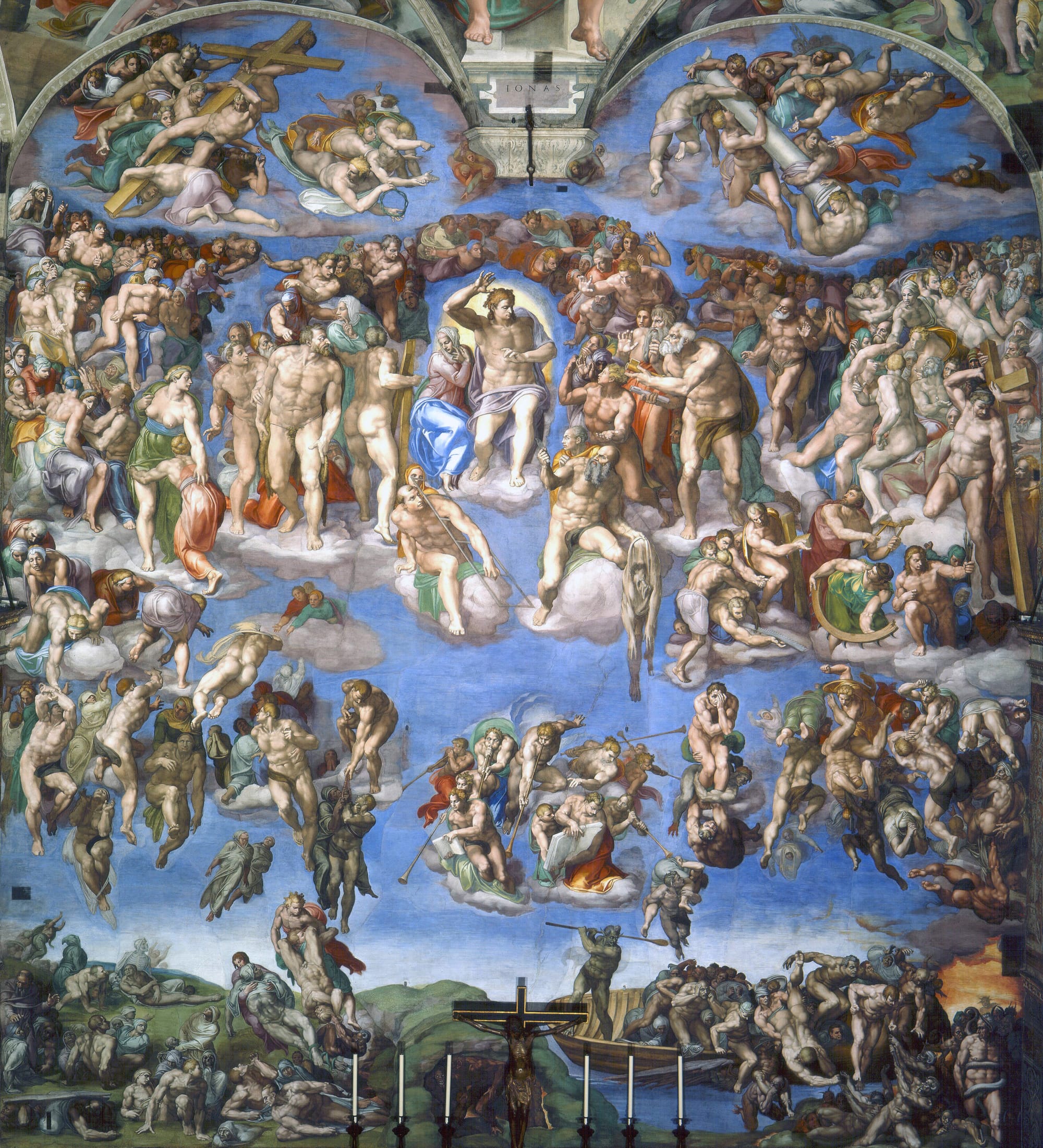
Four months prior I had been to Italy for the first time. I had seen all the usual frescoed chapels in Florence, and had been to Rome, where I bought an absurdly large poster of Michelangelo’s Sistine Chapel Last Judgement. I Blu-Tacked this poster to the back end of my room, so that Michelangelo’s colossal risen Christ could judge me from behind as I studied. The poster near-covered the whole wall, and as the blu-tack dried, the Last Judgement peeled off and fell down periodically. I would come back to my room to find it rolled up on my bed; or I would hear it tumble down behind me as I worked.
So there I sat at my desk day after day, between falling frescoed apocalypse and a war unfolding out of my radio, between history and the end of history, looking out on a winter courtyard, or making notes on King Lear and Moby Dick, on Oedipus Rex and The Persians. I was on the brink of a new life and a fresh new world. The 1990s. The end of history and the beginning of life.
...
Oh my youth! Oh my freshness!
Gogol, Dead Souls
...
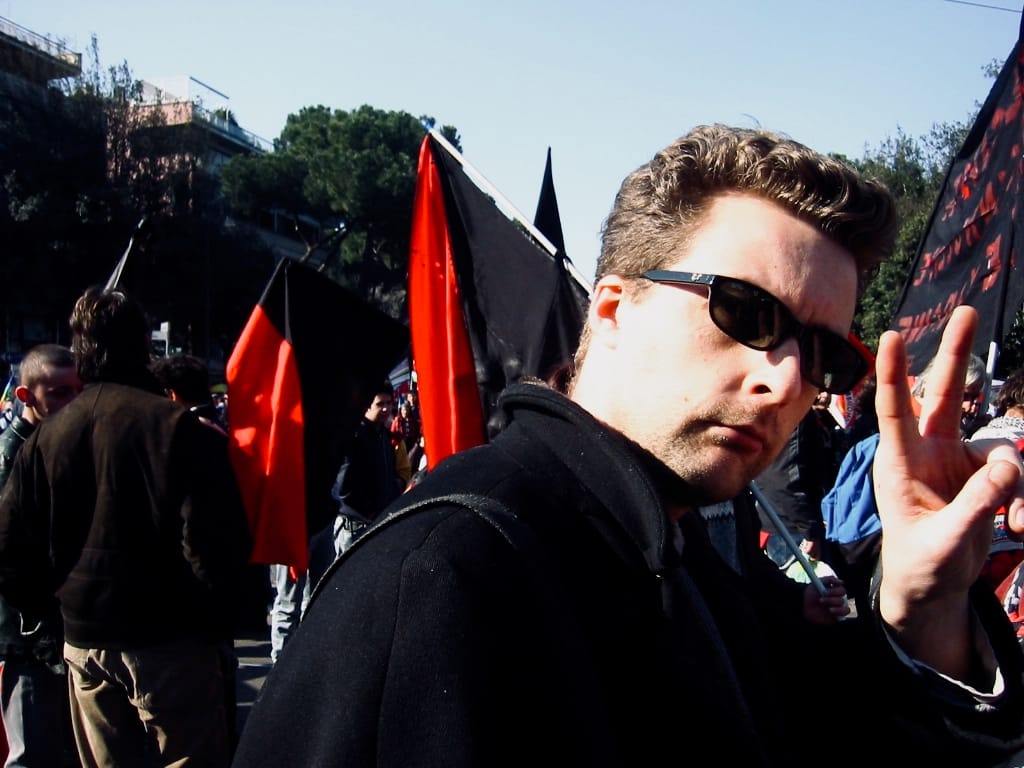
In 2003, after ten years living in Italy, I marched in Rome against yet another Gulf War. I marched with the Makhnovists, a mild-mannered, melancholy subset of anarchists. On that occasion, we failed to change the course of history.
At around the same time, in the month or two preceding my return to England, I visited the town of Arezzo for the first time, and entered the apse chapel of the basilica of San Francesco—the chapel frescoed in the 1450s by Piero della Francesca with his History of the Legend of the True Cross.
When Piero della Francesca arrived in Arezzo to take up the commission to complete the fresco cycle in the Capella Maggiore in the 1450s, he found some scraps of the chapel already painted by a recently-deceased, aged painter, Bicci di Lorenzo, and his team: most of the vault was done, as was the triumphal arch facade of the chapel. All he needed to do was to fill in the history.
But before he could that, he had to remain for a moment outside of history. He had to paint two prophets. One, Isaiah, he deputed to one of his assistants. The other he took care of himself. Jeremiah.
...
Look up. Up to the right as you enter.
There is your prophet, barefoot and alone in his alcove on a narrow ledge, clutching a long unfurling scroll of blank parchment.
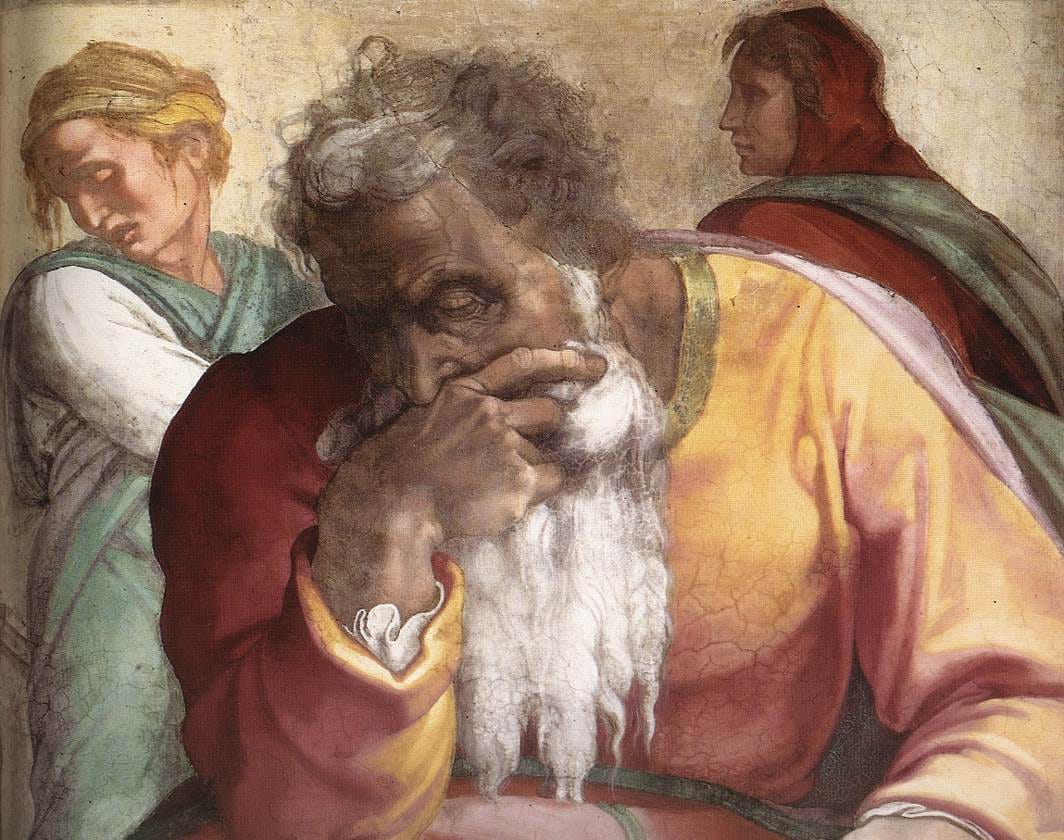
Piero’s Jeremiah is not the grizzled, ruminating, lamenting prophet of Michelangelo, still a long lifetime in the future; he is a young man in a blue robe and a red cloak thrown back over one shoulder to reveal its cream lining. His thick golden hair alone seems to have the power of prophesy; his mouth is downturned in the moment of foreseeing.
And those eyes. This is a fresco cycle of many figures, many pairs of eyes or eyes half-glimpsed, eyes closed, downcast, hooded, dying, melancholy; but Jeremiah’s eyes are notably wide, candid, clear-seeing. But of course. He is a prophet. More, he is a painter’s prophet. A seer.
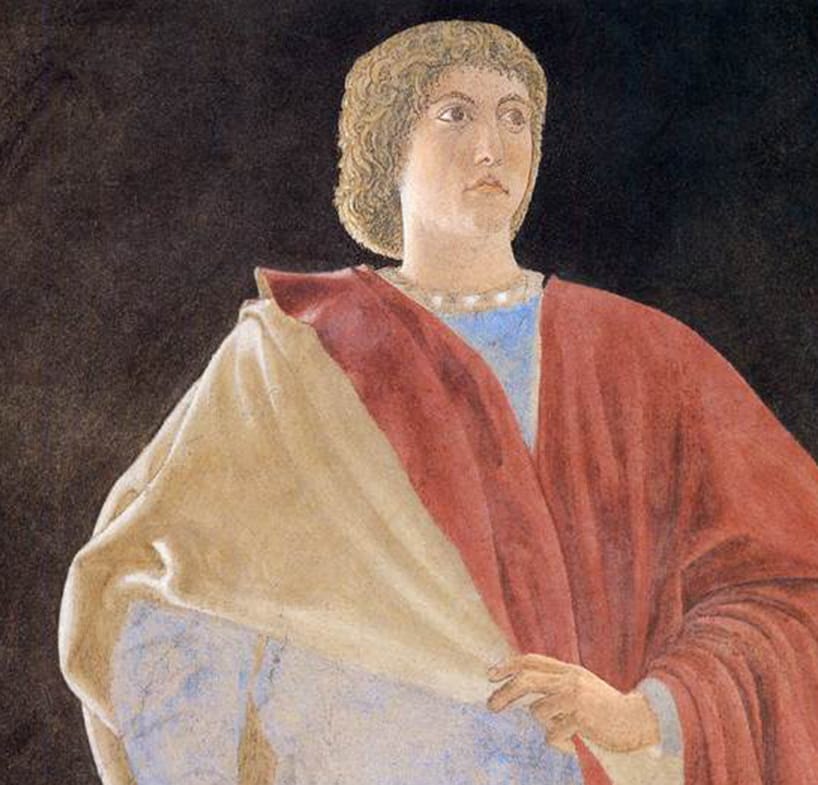
His eyes, then, are wide and alive. His right hand clutches one end of the scroll, his attribute. For now, it remains blank, a parchment on which all possible futures might be written by this youth. But in time, with his clear sight, he will ink his indelible prophesy on it, of the destruction of the city and the exile of its people.
The painting is not yet a lamentation. Piero’s Jeremiah is not preaching out of the bitterness of age. This is a young man, a youth. He might if he wished stride out into the world and self-actualise himself to his heart’s content. He might fulfil manifold destinies. Others would look to him as we once looked to our poets, soldiers, and explorers, as we now look to our entrepreneurs, actors, and athletes, to show us the schematics of what a completed life might look like.
We know of course that he chooses another path. He sees too clearly. He knows. Just as, if we read our poets, we would see that they too knew. As our soldiers in their trauma knew, the broken explorers, the bankrupt entrepreneurs, the shell-shocked athletes clinging to past glory, the ageing actors wondering about their value in a world of superficial virtue. Look into the hearts of people, not on their faces, and sing lamentation.
...
Piero frescoed the chapel at some point in the 1450s or 1460s, in the shadow of an apocalypse of his own: the fall of Byzantium to the Ottoman Turks in 1453.
The chapel into which he walked was not virgin chapel. Bicci di Lorenzo was already an old man when he took on the commission in the late 1440s. Scaffolding was erected, plaster smoothed, and he or his assistants, perhaps his son, began work, on the vault, and on the facade to the chapel. In the four quadrants of the vault they painted the four evangelists against a deep blue empyrean field. And they did a Last Judgement over the entrance to the chapel.
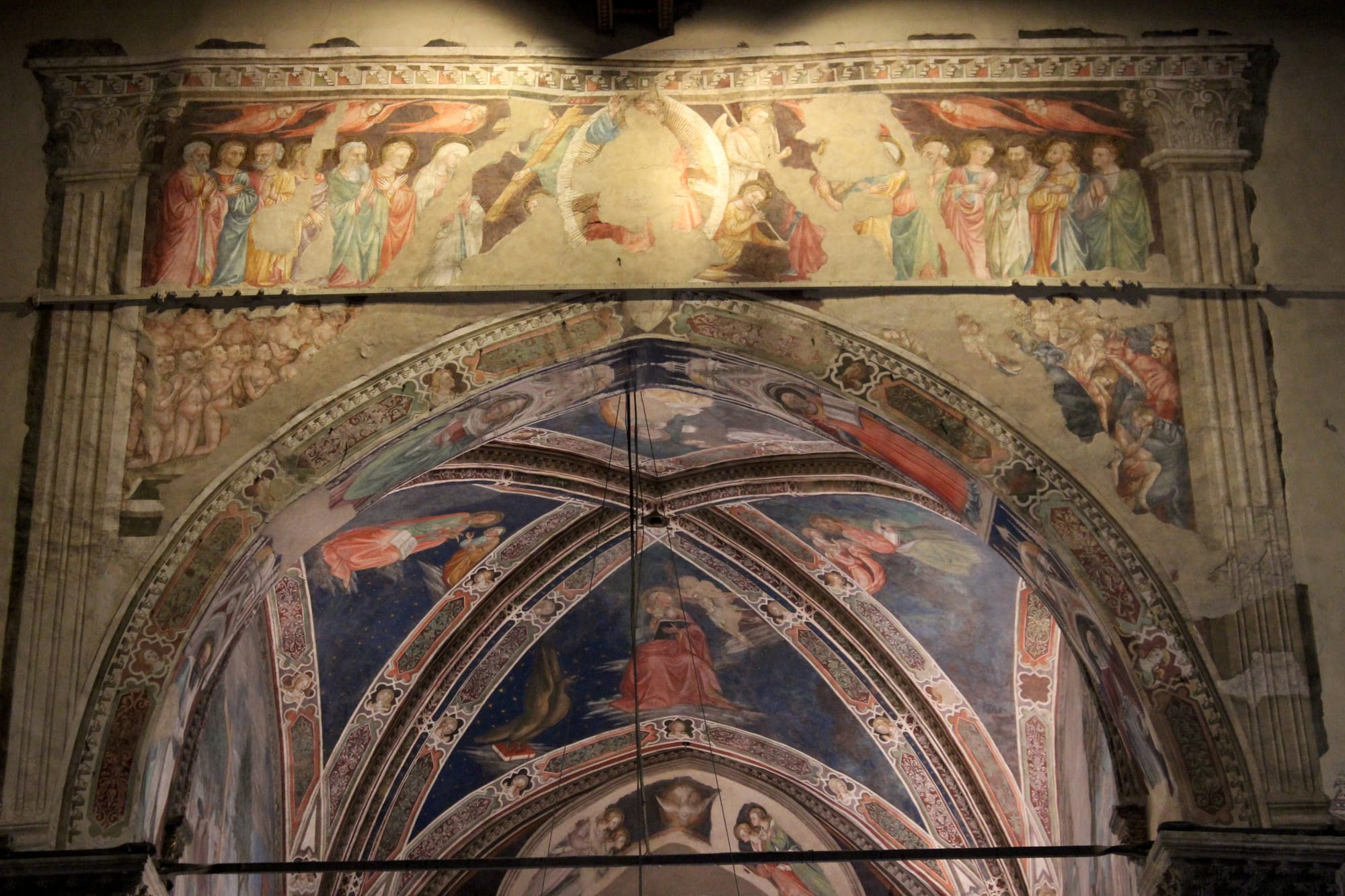
Before work on the vault was complete, Bicci di Lorenzo was taken ill, according to Vasari with chest pains, and retreated to Florence, where he died in 1452.
Perhaps Bicci's scaffold was still in place when Piero arrived, dictating the order of operations; or perhaps the chapel had stood one eighth complete for a decade or more, a Plato’s-cave on which images might be projected by the imagination of drowsy prelates, altar boys, nodding congregations.
Either way, there stands Piero, contemplating his scheme. What does young, or youngish, Piero see, standing there in the chapel in the freshness of a summer morning? A whitewashed plastered wall, damp to the touch, with a rust-red line showing faintly beneath. The smoothness, the smell of damp plaster, the cool of a chapel, the roughness of scaffolding. The faintness of the line, the sinopie, the freshness of the plaster. The possibility, and the insistence of the moment: paint it today, or not at all. you have one day. One giornata.
Outside, Italy is flooded with Byzantine scholars, exiled Greeks. The world is ravelling up from the East. He is going to make a painting of history and its cycles. A narrative of the history of the salvation and redemption of the world, told through the story of the loss and re-finding of the True Cross.
But there remains one lingering question, as Piero stands there, or as we now stand there. One questions which envelops us all, unanswerable. A riddle.
If this is history, says the great invisible Sphinx inside us all, if this is the great shape and arc of things, tending to the salvation of the world; or, if this is the great muddle and chaos of events which over time and many tellings comes to sort itself as if by geological process into History; if this is history, here on the wall, in your head, in the mouths of monks; then what, prey, precisely, are you? You who stand here, or sit out there in the randomly assembled, ever-shifting congregation. Do you have anything to do with it? Can you shape it? Does it shape you? Does it in fact exist at all? Is it all just stories told to children, a tidying away of suffering, of your foreknowledge of imminent extinction?
...
Vasari relates that, towards the end of his long life, Piero della Francesca went blind with cataracts.
Oddly, we can catch a glimpse of the old genius in his blindness, in a reminiscence handed down by one Berto degli Alberti who, in a document he entitled Codicil of Memories, wrote that a lantern maker of his acquaintance, Marco di Longaro, had recalled for him that when he was a small boy, he was deputed to guide the blind Piero around his native Borgo San Sepolcro.
What was Borgo San Sepolcro to a blind painter, on any given morning in the early 1490s? The sun on his face, the impressionistic, not uninteresting play of light perhaps, as he turned his old head this way and that; a jumble of voices near at hand, leaping out, or far off; the warmth in the stones of an Italian town, the smell – sweat, animals, butchery, open sewage. A handful of elements, a simple perceptual frame within which the memory, free to play, might go back to the cool of a chapel, not far off , a day’s ride. A chapel in Arezzo which he had frescoed, decades earlier, for the Franciscans there.
And what, we might further wonder, was Borgo San Sepolcro on that same morning to the young Marco di Longaro, the boy deputed to guide the ancient blind man at a snail's pace through a city alive with possibility, with freshness, to a boy itching like all youth to be gone, off, over horizons?
...
Come to think of it, that first visit to the Piero chapel I made in 2003 was not, in fact, my first time in Arezzo.
On my inaugural trip to Italy in the summer of 1990, Kuwait already sweating under the Babylonian yoke, my girlfriend and I were thrown off a train. We were returning from Florence to Rome for our evening flight back to London, but our tickets, it turned out, had expired. The conductor threw us off at the first stop. We bought fresh tickets, but then sat and watched our train pull into the station and out again, having, with our non-existent Italian, misunderstood the time the man at the ticket office had told us. Our only chance, he now said in halting but effective English when we returned to him, was to take a taxi to Arezzo, twenty miles away, and pick up the express.
And so my first visit to that town was at helter-skelter speed: we jumped from the taxi while it was still moving (in memory), sprinted for our train, sweating that we might miss our flight, clutching too many bags and an outsized poster of the Last Judgement. Arezzo was gone as soon as it was seen, was for years just a name in a story, a flash on the retina, a stage set against which hilarious, inept youth played out, while it dashed off elsewhere.
...
A footnote.
When I visited the Sistine Chapel in 1990, I did not see the Last Judgement. It was concealed behind scaffolding and tarpaulin, the last beneficiary of the lengthy restoration of the whole chapel. Over the tarpaulin, they had attached a near-actual-sized reproduction of the work beneath. Held there, perhaps, by drying Blu Tack.
What emerged from the restoration, some years later was a delightful pastel decoration. The restorers removed centuries of smokey candle wax, the traces of earlier restorations, touch-ups, and, some argue, the almost intangible final layering of Michelangelo, the so-called patina which brought the flat first fresco layer to life, moulded the bodies, adjusted the light. Lifting the dead surface into the realms of the real. What the restorers left behind was either bowdlerisation, Disneyfication, or illumination, depending on your taste or your knowledge. But whatever it was, it was a painting for the 1990s.
The poster I bought was therefore a reproduction of the unrestored version: dark, brooding, oppressive, hidden under tarpaulin. Not a Last Judgement for this brave new post-Soviet, post history world, but a Last Judgement for a corrupted, brutalised world. A world we were leaving behind. It was a fresco, as it happened, nearing a death and a resurrection of its own. Michelangelo and I would shortly be stepping into a new fresh-minted world.
Member discussion