In Tents
When my brother was a boy he was gifted a tent. It was an orange tent, roomy enough for two. He had, I think, specifically asked for a tent, but what vision or dream of liberation he was expressing in this desire I do not know and do not suppose he can remember. However it was, for some years the tent was only ever pitched experimentally in the middle of our back garden. Once pitched it would remain in place, for week after sagging week, until, I suppose, my father grew tired of its dispiriting presence and roused himself from the equally sagging green Chesterfield whose supreme gravity organised the front room of our house for us, to demand that we dismantle it. Then it would be shaken back to life, smoothed out, rolled up with its various pegs and poles, and stowed probably not far from my father’s own heavy canvas tent, acquired at some point I think in the 1950s for purposes unknown, and never in my memory brought into the light. My father, by then, was well beyond tents. He had made his permanent dwelling in the irregularly-buttoned, erratically sprung folds of the Chesterfield.
Years later, after I had left school, I took the orange tent on an abortive assault on the Pennine Way. I was with two friends, Aidan and Joe, and we were hilariously unprepared. Our packs were overladen with irrelevancies, we were unable to heat water for tea or soup because the clunky stove we had brought was designed for a summer campsite at sea-level; Joe had turned up in a pair of trainers. On day one in the Dark Peaks we got lost in the low clouds, and descended at one point into a vast, empty, glaciated valley in which (I may have dreamed this) we stood in a vague exhausted silence around the mangled silver wreck of a antique jet fighter of some sort; and then, that first evening, we were caught in an almighty storm, only to find that somewhere or other in our psychomachia on the blasted moor we had shed the rain-sheet of the tent. We spent a horrifying sleepless night in the teeth of the gale (how the tent did not simply blow away with us in it, I do not know), as a puddle slowly formed around whoever was sleeping in the middle – I think, Aidan – before we gathered ourselves together and descended, exhausted, to a small town in the valley where reverentially we ate a full English breakfast in the first open cafe we found.
The bright orange rain-sheet is, unforgivably, probably still ghosting around up there somewhere whenever the wind gets up, if it is not tangled by now in the wreckage of the ghostly plane.
I have written elsewhere that for the Sámi people, the tent which accompanies their reindeer migrations is so organised as to represent the ritual centre of the cosmos. Wherever you pitch your tent, there is the fulcrum of the universe. From a perceptual perspective this is of course correct, since wherever your head happens to be, there the universe is necessarily centred, insofar as it is centred anywhere; and from a social perspective, a village of tents in perpetual motion across an unvarying landscape of tundra might as well express the centre of all things. For the rest of us, however, now that our lifeways are no longer characterised by onward motion but by the gently insistent gravitational pull of settlement, we are paradoxically forever displaced from that centre, that fulcrum. To spend prolonged time in a tent most likely feels, to a refugee or migrant worker, or to many people on many dreary campsites, like the apogee of displacement; to someone labouring under what Bruce Chatwin liked to call the malaise of settlement, however, it feels, for a few short days in the year, like you are once again approaching the event horizon of that lost centre.
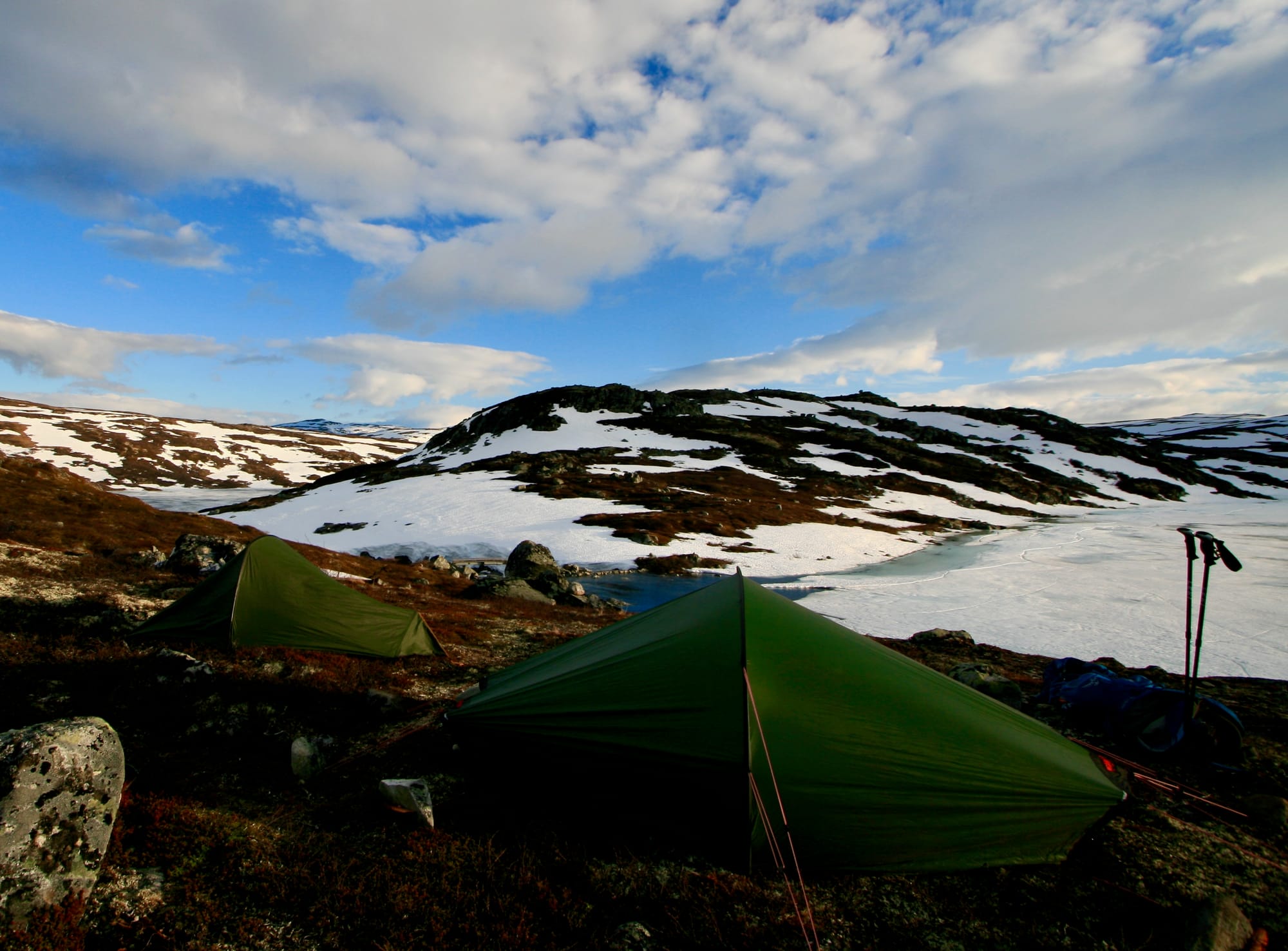
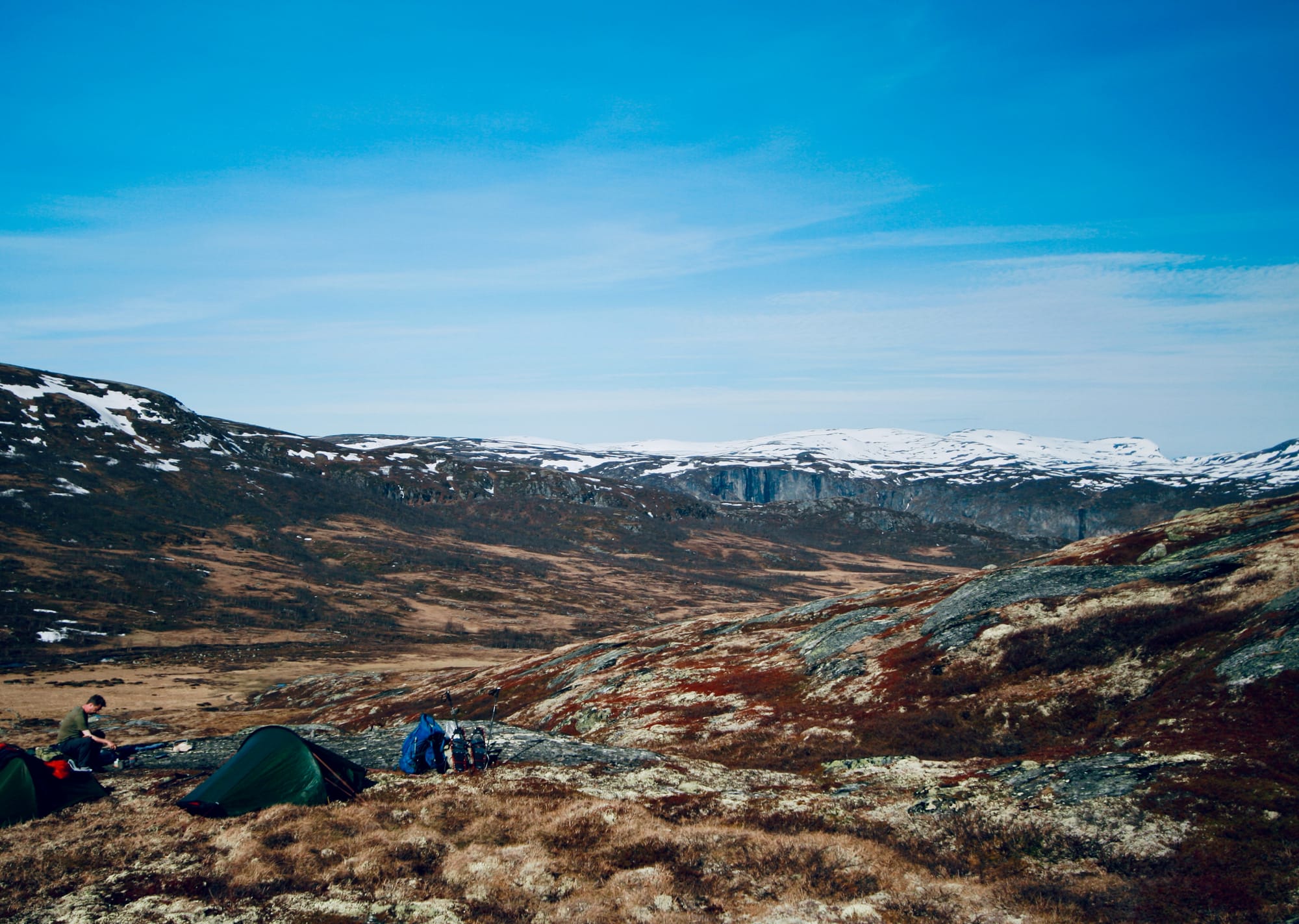
Many years after the demise of the orange tent, I bought a small forest-green tent with, in subconscious homage perhaps, an orange inner skin, for taking to wild places. For aficionados, it is a Vango Helium 100, a three-season, one-person tent which rolls up into a narrow lozenge weighing something around 800 grammes. Vango is a Scottish company: twice I have returned the tent to them for repair, and both times it came back better than ever. Unlike my brother's rather lavish Hilleberg Akto, it is always slightly saggy, and cramped inside, with only a negligible porch; but it is virtually indestructible. I have pitched it over the near-twenty years I have had it in a great many odd corners of the world – from its first pitch, next to a reservoir in the Brecon Beacons, to the uplands of the Chihuahuan desert by the Rio Grande in Texas (its most recent). In between it has sheltered me in the ice and snow of the Hardangervidda plateau in Norway, in the waterless White Mountains of Crete where the scops owls played ping-pong across the valley over our heads; under Mulhacén in the Sierra Nevada in Spain where the wind streamed as keen as I have ever known it; just below the grey summit of Gros Morne in Newfoundland, on the shoulder of Yr Wyddfa, variously in Iceland, Sweden, Scotland. Elsewhere.
I do not love sleeping in the Vango. I enjoy the ritual of pitching it, and the minor associated disciplines of wild camps, stowing the gear, tautening the ropes (never taut enough) setting up the stove, brewing tea, drinking a beer.
The nights, however, are long and broken. If you are in bear country, you hear things, and cannot sleep. I occasionally suffer mild claustrophobia (the interior of the tent is tiny, the ceiling an inch from your nose as you lie there) and have to leap out to remember what extension in space feels like – on one occasion, in Montana, it was so cold and the stars, seen through my watering eyes, were such bright dancing globules that I got even more scared by my evident distance from any cosmic centre, and had to climb back into the comforting warmth of my sleeping bag. In short, I rarely sleep well, and the nights can play out endlessly.
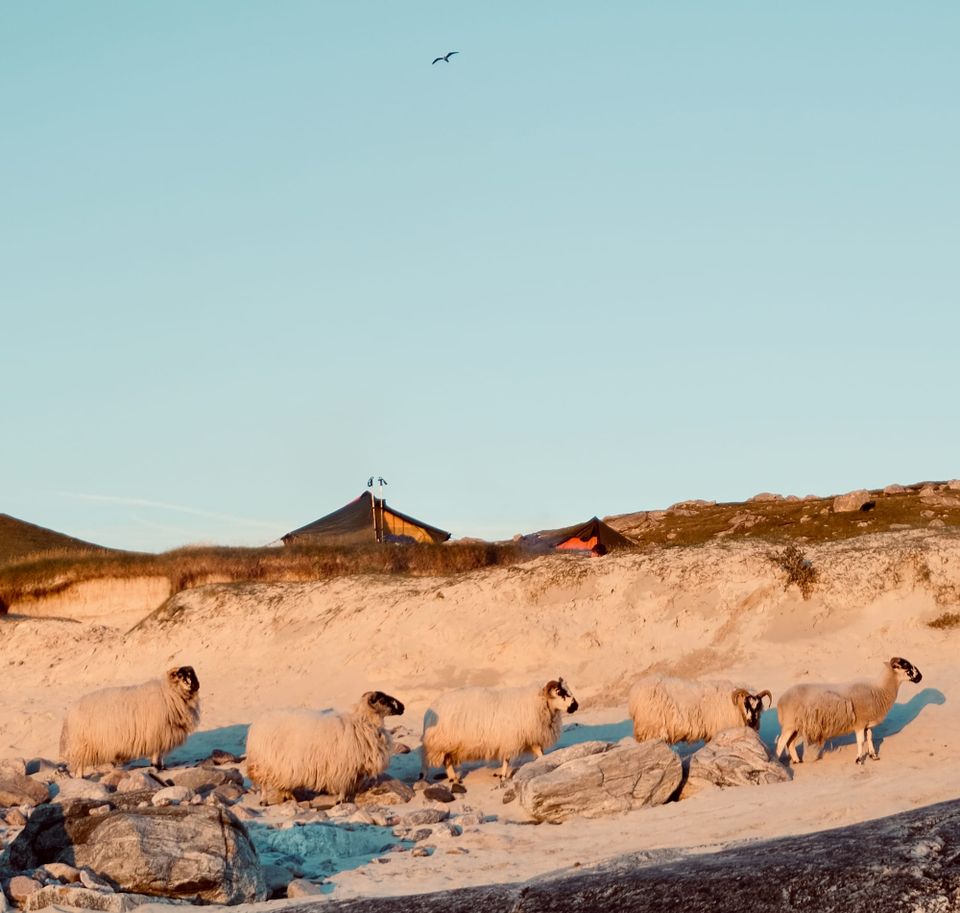
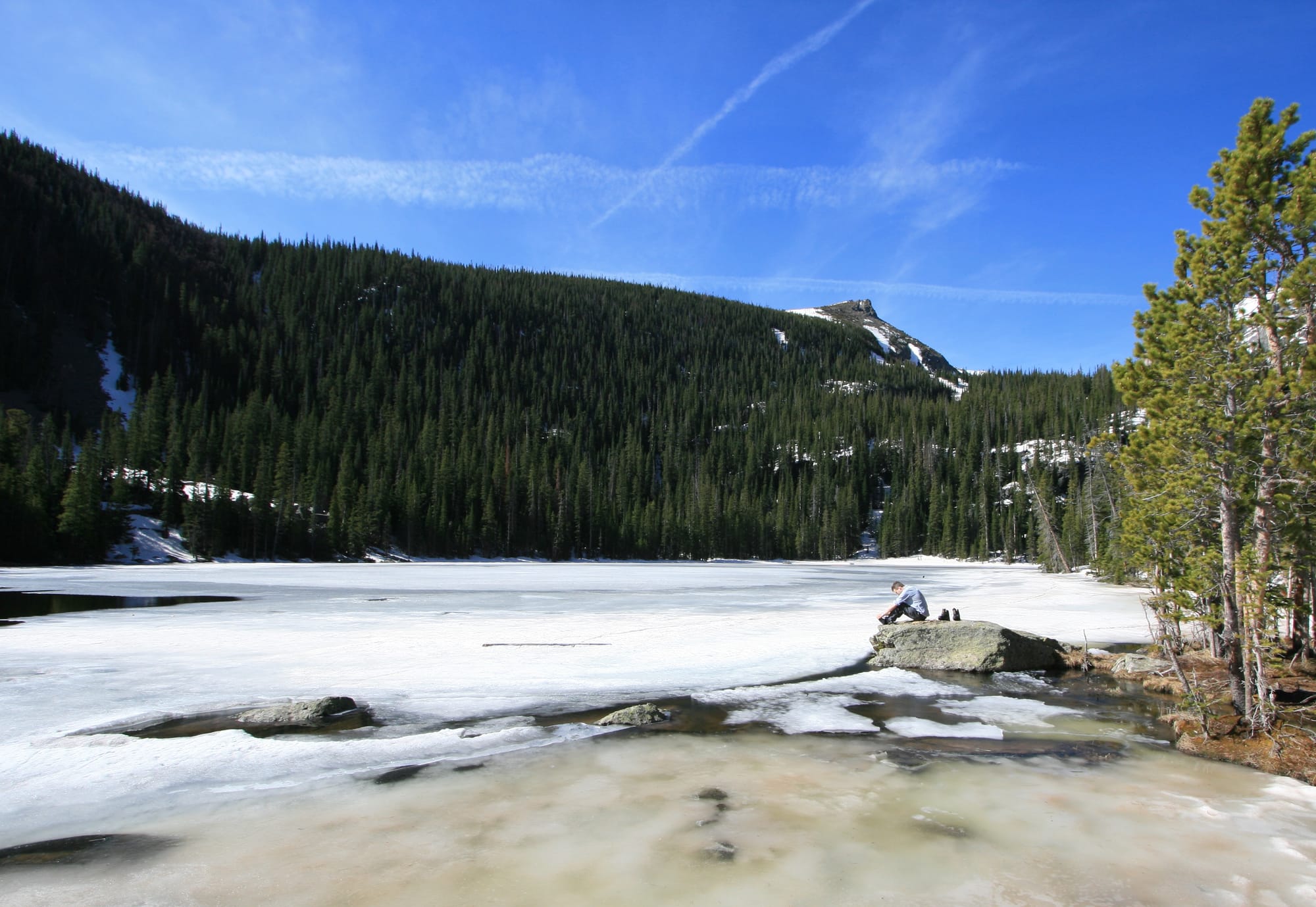
But then finally you sleep a little; and then wake; and waking, I think, is the whole point of it. More often than not you wake very early, at first light; and you wake into a pristine world. So often you arrive at your pitch in the dark or gloaming; on waking you see it for the first time. What do you see? At Fern Lake, a small enough body of water high up in the pine forests of the Rockies, you wake to tiny birds darting over the sun-skittered icy surface, and feel the warmth on your face as you sit in silence breathing over your coffee; in Newfoundland, you wake to a fjord as still as glass, and run from your tent directly into the freezing water, in the brilliant sunshine, and you are awake; high in the Sierra Nevada in Spain you wake to ibex wandering through your camp; in Sweden, to a small pod of scuttling reindeer; on Harris, to a respectful file of beach-sheep. You wake, in short, and if you are patient and lucky, to some minor fragment of Eden, catch a glimpse of it while you boil water for tea, or fry bacon in its own hot and spitting fat. You have somehow dragged yourself to the creeping margin of the destination we are always searching for. The deep order of the camp, the pack, the small tent. Soon enough the marginal place will move on, in the wake of Earth's terminator, and we will strap on our packs and wearily stagger after it. But not quite yet. Not before breakfast is done.
There is a panel in Piero della Francesca’s fresco cycle in Arezzo, The History of the True Cross in which the emperor Constantine, on the eve of the Battle of the Milvian Bridge, has a dream vision of a sculpted angel holding up for his inspection a tiny cross. The emperor is asleep, in his rhubarb-and-butterscotch tent. His servant, the earthly, rooted counterpoint to the angel, is wakeful, and regarding us balefully.
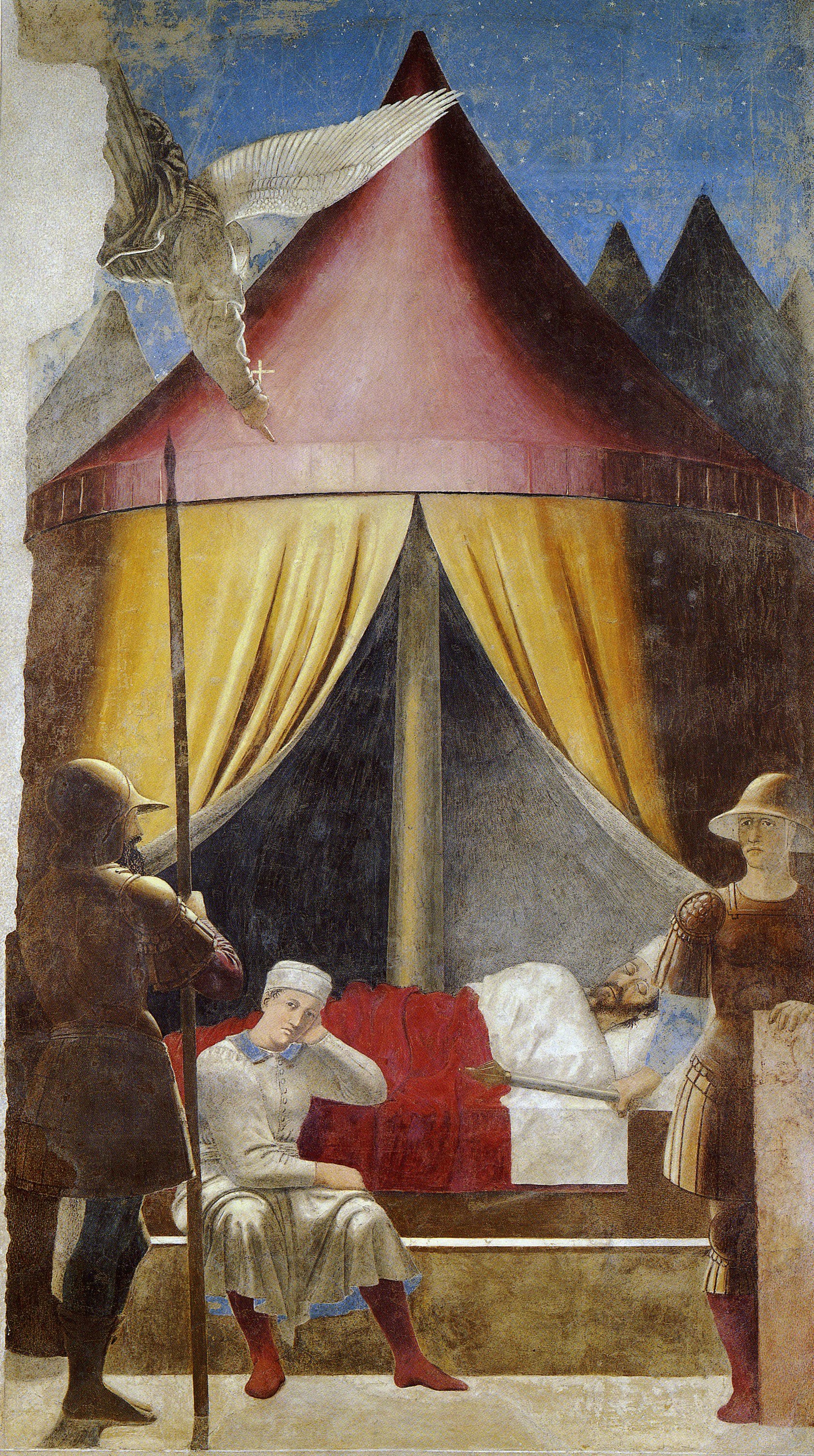
It is a morning dream or vision. The light in the sky over the little tent city of the army is a pre-dawn light, the fateful stars are still doing their descriptive or prognosticate pagan labour in the deeper blue-black sky high above, but the light of a Christian dawn, on this eve of the Christian Roman Empire, is pushing them back, switching them off one by one, making them irrelevant. God's singular sun, intuits Piero with his brush, is rushing to the sky.
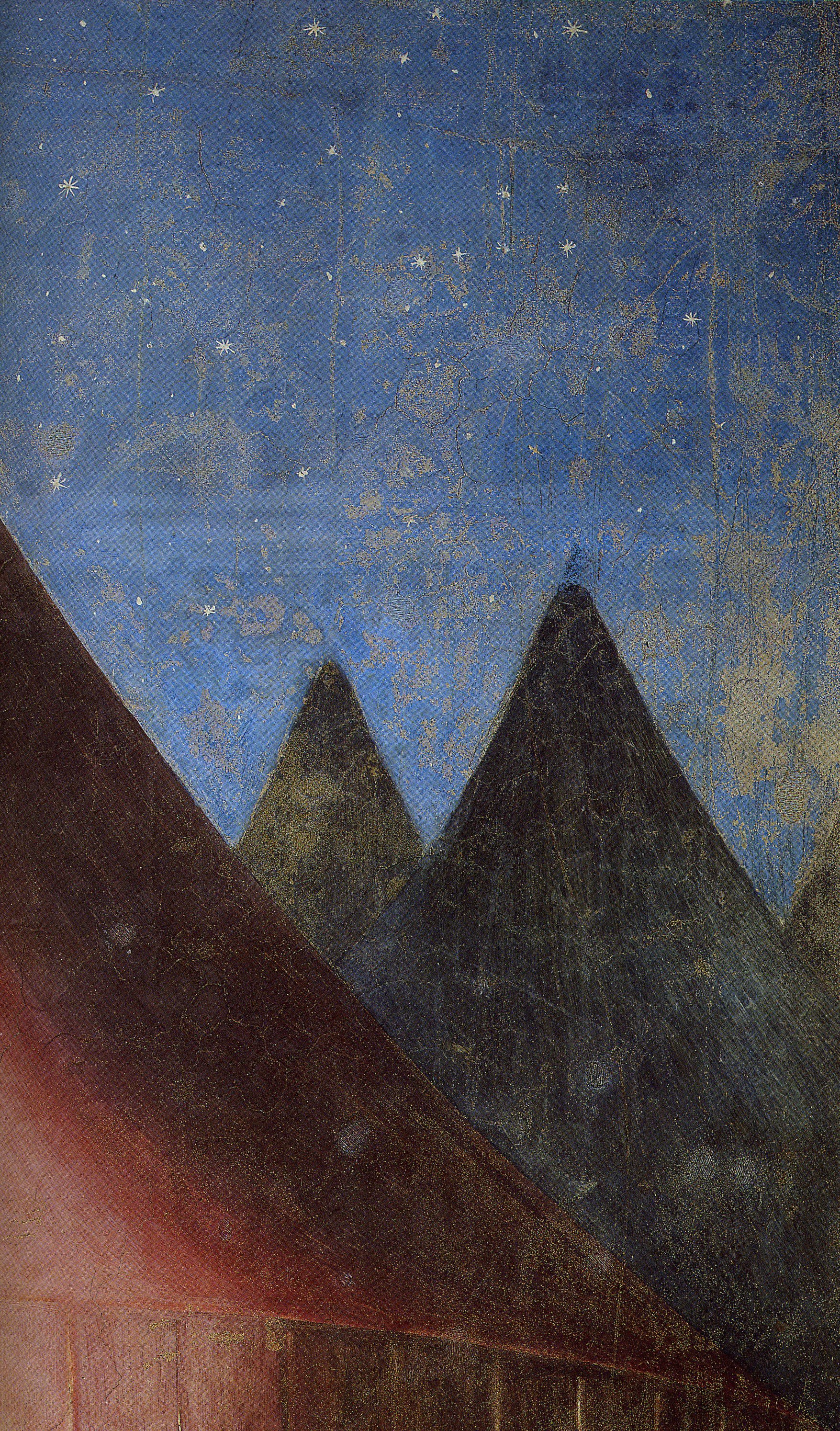
And in order to notice this little play of light and dark, we are forced to notice the points of the tents under which the army sleeps. Serried tents are a emblem and a fact of an army on the move; an army, like a Sámi family shadowing a reindeer herd, is a mobile, menacing, nomadic presence.
Still, this army, this proto-Christian army, is an army for now asleep in tents, like the chosen people in Sinai. Monotheism is a nomadic inheritance, as Bruce Chatwin was fond of noticing; the great monotheisms of Judaism, Christianity, Islam, were all born of desert peoples, but codified and institutionalised in cities: Rome, Jerusalem, Medina, Constantinople.
From time to time we must shake ourselves free, and remember. The tent, if we let it, still speaks to the miniature order of the cosmos. To know our place in the cosmos, we must painfully detach ourselves from our settled reality and pitch ourselves into the wilderness, or its simulacrum. Only there, if we are lucky, and if we wake early enough, will we be vouchsafed some vision at dawn, as we emerge on hands and knees, limbs stiff and reluctant, into the cold vast empty air, where over horizons, battle awaits.

Member discussion