The Good Fresh
begin afresh, afresh, afresh
Philip Larkin
You’d rather have the image in your mind than just have to look at it.
Philip Guston
Let us walk the empty streets of this ancient city in the freshness of the early morning.
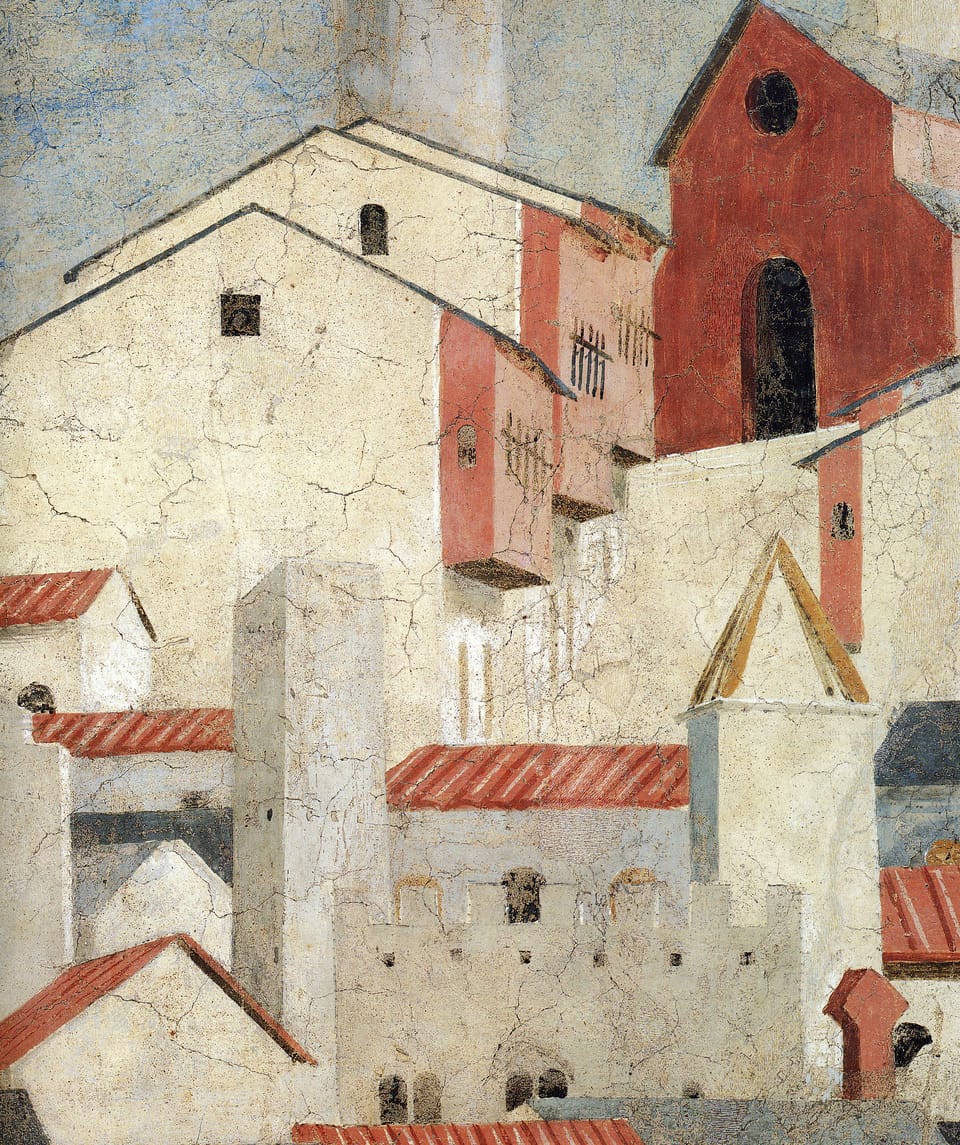
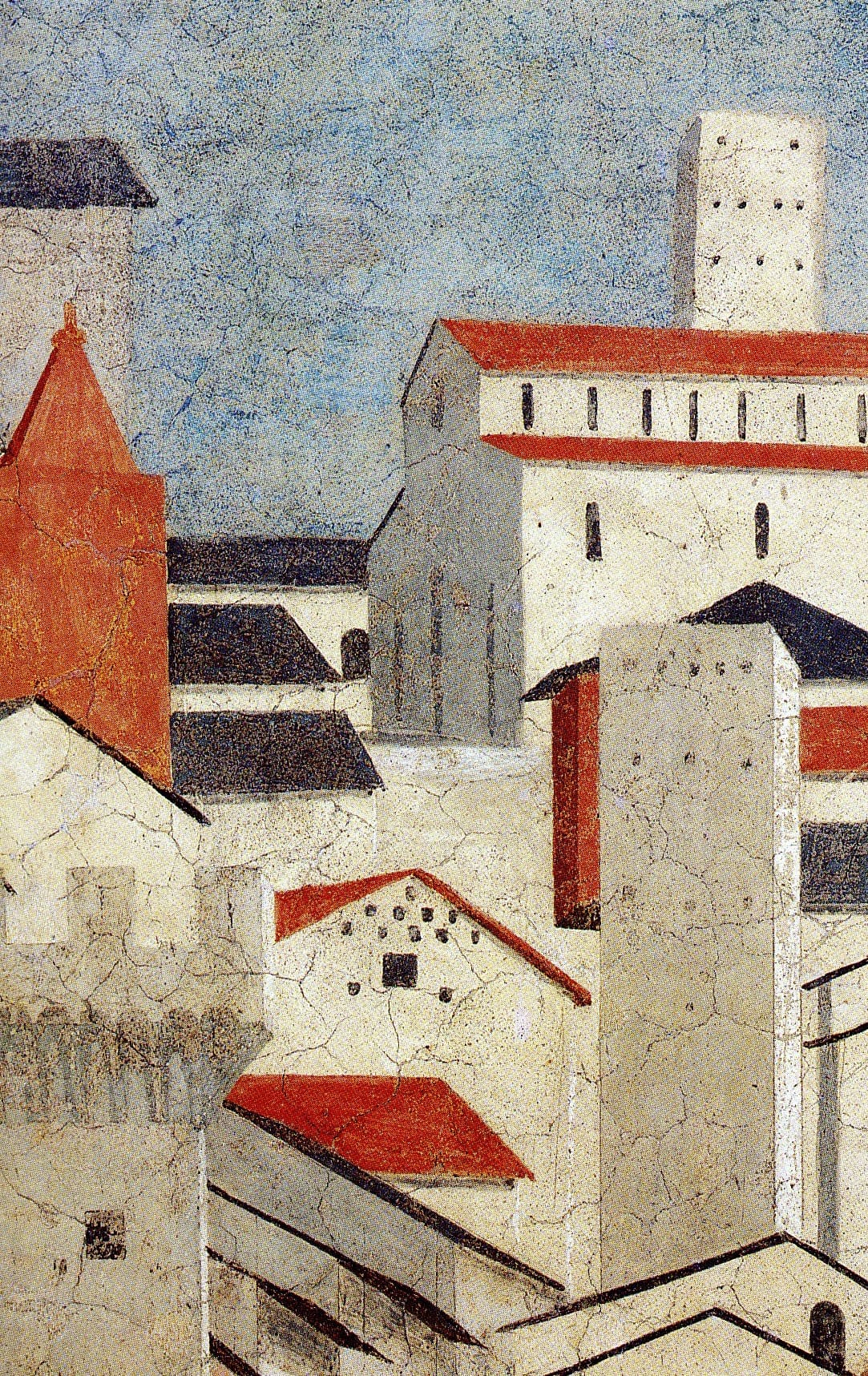
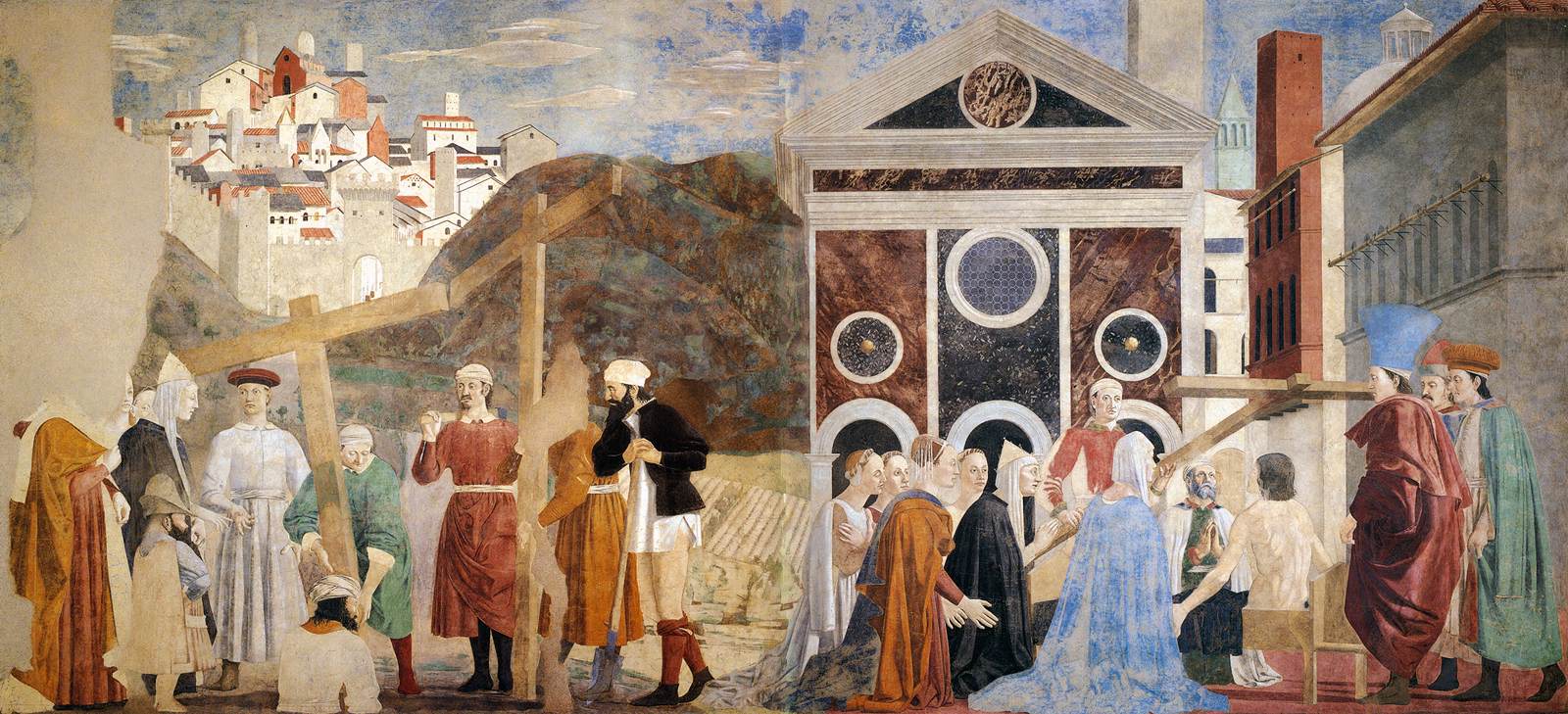
City? It is not a city. It is a medieval hill town. And it is not a town either, but a picture. A picture of a small hill town, painted by Piero della Francesca in the 1450s; a fresco, painted in the correct manner, the buon fresco, the good fresh, painted while the plaster is still wet; a picture of the town of Arezzo, town part-remembered, part-imagined, part re-imagined as Jerusalem, for the purposes of this fresco cycle.
Let us nevertheless walk the empty streets of this city in the freshness of the early morning.
Standing in the chapel where the fresco actually is – the apse chapel of the church of San Francesco in Arezzo – you will not really see the little painted city unless you close your eyes. You will not see it, because the chapel is tall and narrow and the picture of the city is a not-considerable part of a large frescoed panel. It is high up to the left as you face the altar. Crane your neck if you like; without a ladder, or a plank of scaffold on which to perch, you will see little, a mere suggestion of city, a higgledy pile of while geometric buildings, cubes and cylinders, oblong towers and planes of roofs.
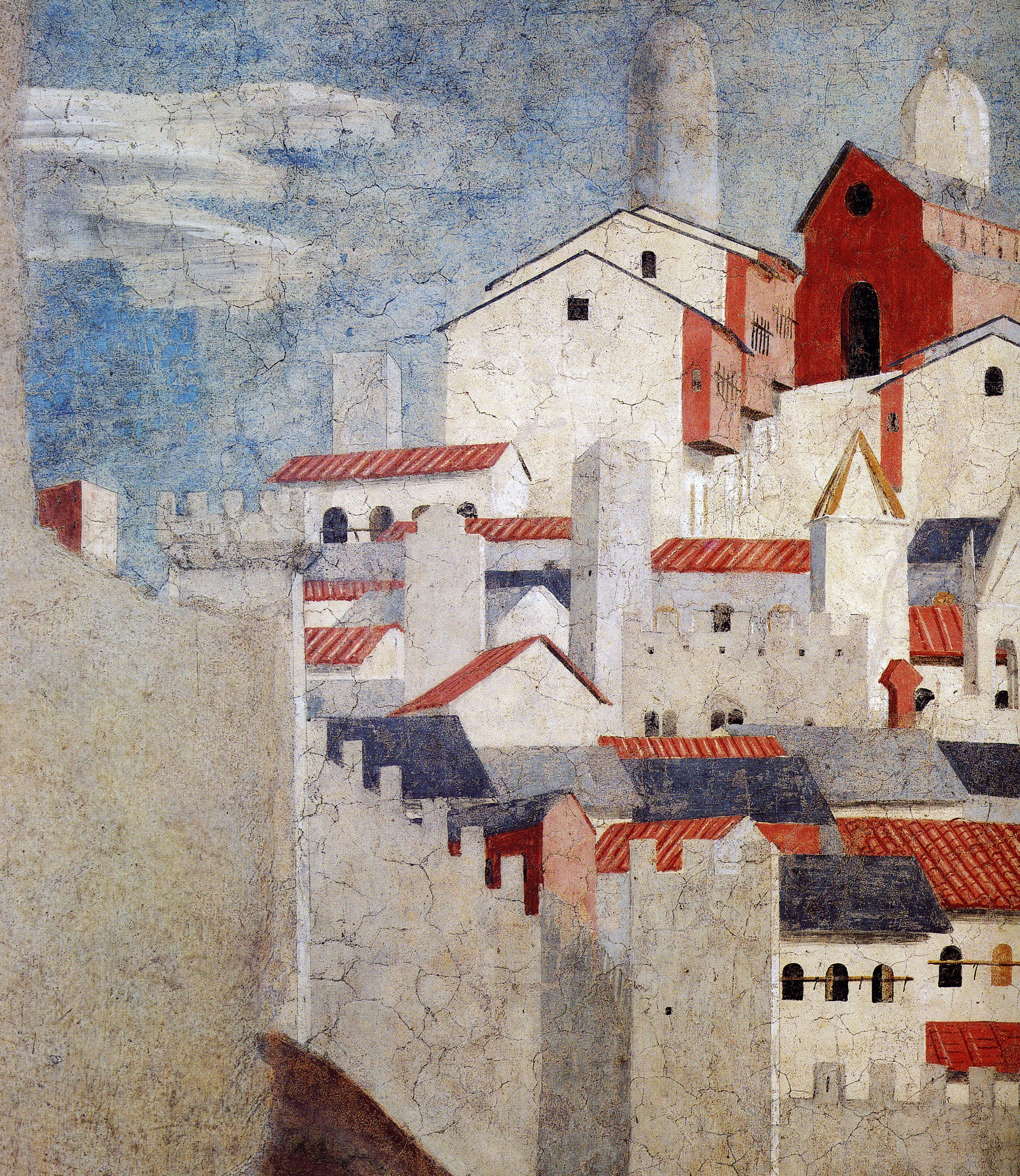
So you close your eyes. If you have done the job of memorisation thoroughly, carefully, you will see much more clearly now. You will see the crenellated walls, the open gate in the tower inviting you up and along its first street; you will trace the curtain wall along to the right, to the brown curve of the hillside; or to the left, where it is lost in a lacuna of grey cement, another brown hill. Or you could climb the gate tower and float off over the roofs, towards the crowning red cathedral and what look like grain silos but are probably intended for the onion domes of the Holy City.
Off to the right there is another church, the church of San Francesco. The church in which you stand with your eyes shut, imagining the picture of the church in which you stand.
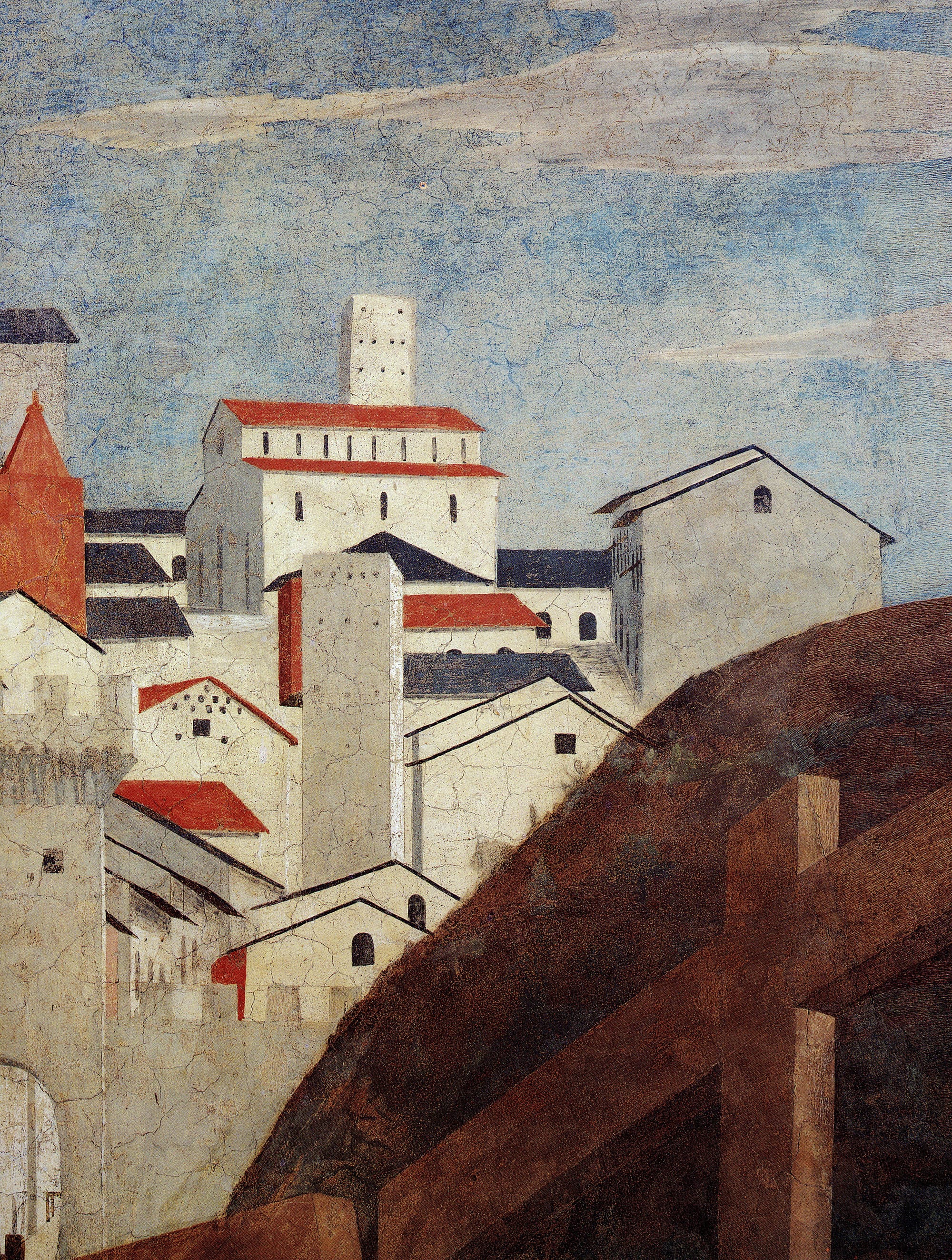
From the imagined interior of that small imagined church this whole chapel, and the bricks-and-mortar church whose apse it constitutes, and the square outside the church, and the streets and city beyond – everything, if you are philosophically inclined to idealism – springs. Everything: all reality, with its carnival of folk, its pageants of history, a pop-up cosmos. You can, if you wish, open your eyes, and move about it in it. Go out into the real Arezzo and drink actual coffee or sit down and order a plate of material pasta, enjoy the physics of the sun and the biological life of the place as it plays out in front of you.
You can do all that. But you are, most likely, not in Arezzo.
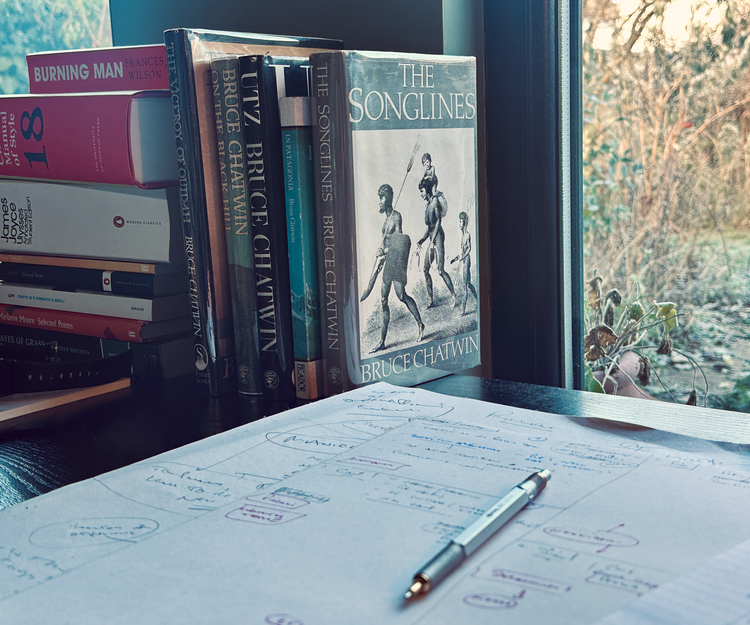
No more am I. I am not standing in a real chapel in a real town. I am sitting cross-legged on the floor of a small room, four metres by three. I am sitting on a folded red and black woollen blanket which I stole many years ago from a French train; there is cup of black coffee cooling on the floor next to me. And a foolscap notebook and a propelling pencil, in case I need to make notes. If I open my eyes I see, not a frescoed chapel, but, through ceiling-to-floor windows, a garden, rain-dampened this day in late February. All real enough.
Outside the window to the right are two birch trees, saplings really, upright and spare; there is another to the left. Piero trees, marking out the perspective.
I am attempting to memorise the fresco cycle of the Legend of the True Cross, painted by Piero della Francesca in Arezzo. Memorise each panel, each figure, each space and volume, each lacuna of cement, each brush stroke, each eyelash. How long can it take? Fifteen minutes a day, with my coffee.
Fresco – true fresco, the good fresh as Italians call it, il buon fresco – is painted directly on to the wet plaster. You only plaster as much of the wall as you will paint that day, over eight, ten hours. The days are called giornate, which is, roughly, work days. What Piero painted in eight hours, I can probably memorise in one. Four quarter hours. Four coffees. And a fifth, to sweat the connections, between one giornata and the next. A week, for each day. Many days of painting, many weeks of memorisation.
I clear my head, shut my eyes, pick a detail, and try, one way or another, to remember.
...
One way or another.
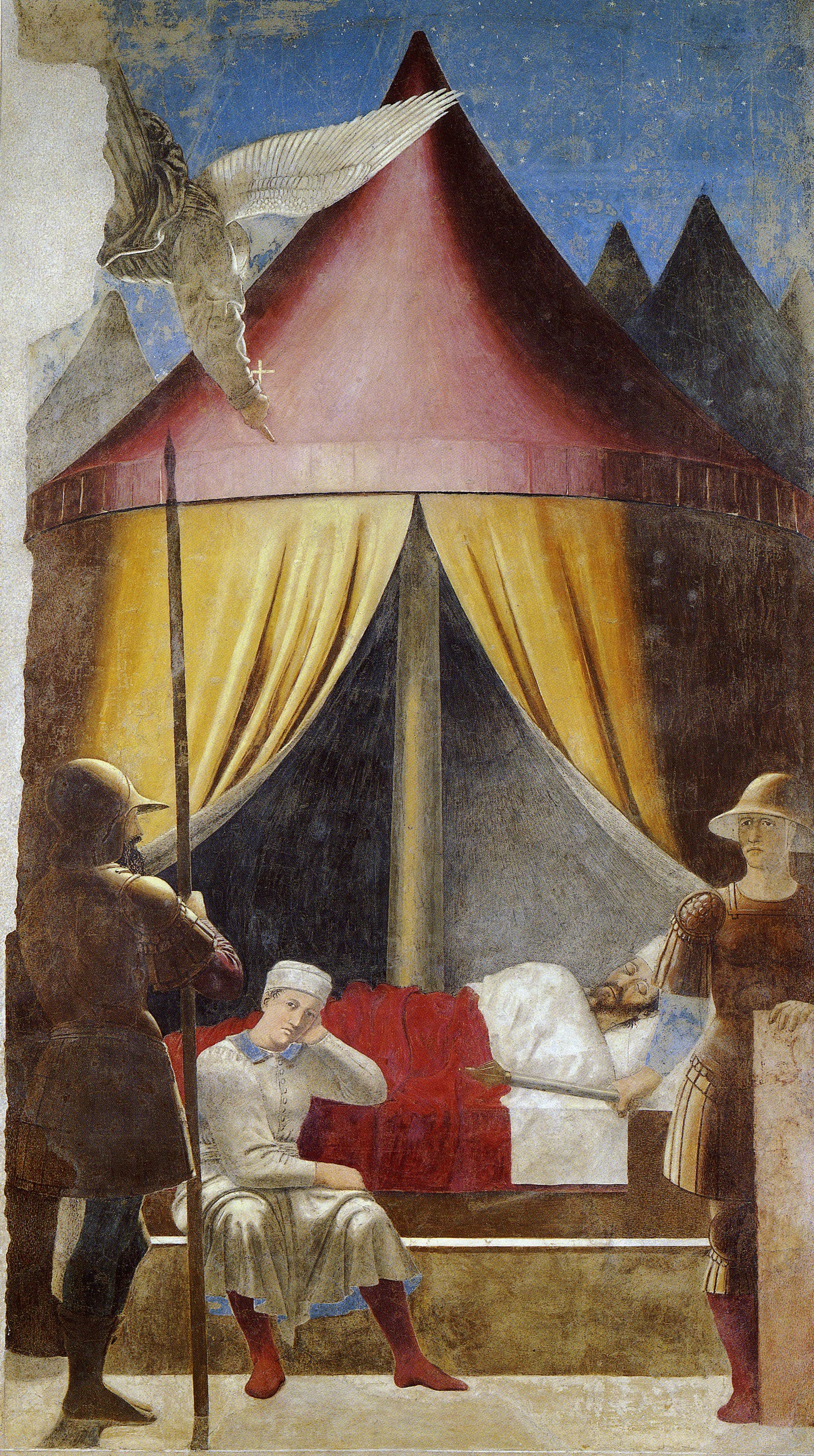
Some figures or passages are easy enough to visualise – The Vision of Constantine, for example, is well-known; although if you descend to details of armour, posture, fold of cloth, button, even down to sprinkle of stars and constellations in the dawn sky, it can become challenging.
Some figures you have to piece together from explicitly remembered detail, a litany of verbal clues, as though progressing through a Ciceronian memory theatre. Is Seth’s toga when he addresses the angel slung from his left shoulder or his right? (left). Are his fingers wrapped clockwise or counter-clockwise around the branch of the tree of life that he places in the mouth of his dead father? (counter-clockwise). Are his feet visible as he stands behind the sitting Adam (yes, just – five toes on the right foot only).
Some of the panels are harder to recall in detail than others. The battle scenes are dense jumbles of arms and lances; it is necessary to proceed by strictly limited giornate framed by horses’ heads, lances, flapping banners. Only slowly do you organise them, make them available in memory. In truth, you cannot proceed by giornate, you have to let the mind wander a bit from zone to zone.
When I lie awake in the dark in bed, I chase away anxiety by running through yard after yard of the cycle again, tracing the flow of line from one figure to the next, one giornata bleeding into the next in the spilled ink-wash of night. But I always end at a blank point, a question, a lacuna of some sort: does this dying man buckle his belt to the left or the right? what can be seen through the windows of the perforated tower? I will have to check in the morning.
Most mornings, sitting cross-legged, I scroll through the images in my head as I might turn the pages of a book: I see the image front on, close to; but some mornings I start by imagining myself in the chapel itself.
Chapels are not galleries; they are imperfectly designed for the viewer. Frescoed chapels are spaces which you must move through, around; you can never capture the whole fresco cycle in your eye at one go, from one vantage; you must move, stretch, peer. And I know this to be an especially narrow chapel, and tall.
So now and then in imagination I sit myself down in the chapel cross-legged (as I am sitting now, in fact, in my room), and take a moment to conjure the whole space: the dark, unfinished nave of the church, the echoing of footsteps, perhaps some voices, off; a door swinging or slamming, someone walking across the body of the church. Sometimes I imagine myself with a thermos of tea, or a piece of toast. I can do what I like in here. Alone in the apse chapel of my memory or imagination. I experiment with rotating the images slightly, the lunettes in particular; imagine that I am looking at Adam and his woes from below, at an oblique angle. Or I imagine myself floating cross-legged like a buddha up, up into the ceiling of the apse chapel and looking at the fresco front-on as Piero or the restorers would have seen it, but as it was never intended to be seen. Here I float, buddha of the chapel, with my tea in one hand and a piece of toast in the other. Remembering.
At length I discover that if I tip my head right back – really tip it, here in my room – eyes still shut, I can suddenly see clearly. As though I can fully conjure a place in memory only by enlisting my body, my proprioception, my inner gyroscope. I need to tilt to see tilt. I cannot imagine looking obliquely at these images if my head is level. Tipped back, I suddenly see how it must be. My body is entering into the spirit of this. Corporeal seeing.
This is momentarily pleasing. But I realise the implication: sitting here, in my still, silent isolation, I have been truncated. The only way to know the world is to move through it. To tilt your head in it.
And so it goes on. Figure by figure, day by day. And from time to time, like a proper mystic, I experience a moment of clarity. For just a moment, just a few seconds, something clicks. As if until this moment I have just been taxiing along a runway; in recalling verbal details (this horse is caparisoned in green) I have been running my preflight checks, ticking boxes, doing the routines; but at a certain point I lift off. My wheels go up. Suddenly, in my mind’s eye, I can actually see. I can picture the object, emerging through clouds of data. As though, almost as though, I were standing in front of it. Or floating. Sometimes one figure, sometimes another leaps out of the flatlands of verbal or rote memory. I suddenly see the woman in the wimple whose head is reversed in the meeting of the Queen of Sheba – she is there before me – or the wild horse’s head intruding on the Milvian bridge. And not just visual sense is suddenly engaged, but all sense – the smell of lingering incense, the acoustic pressure of a chapel, the echo of the footsteps of the sacristan as he crosses the body of the church.
Sometimes one figure, sometimes another. And sometimes, I see these crystal images as though from a spot on the flagged floor of the very chapel I am imagining myself in. Who is to say I am not there? A ghostly transportation, not to an actual chapel, perhaps; but to a substantial dreamscape.
...
In here, in my garden room, for now, there is only this little white invention of a city. Outside – beyond my garden, my idea of a Pieroesque garden – there is the world. Things happen. Events. Suffering. War rages. Elections happen. Queens die, kings are crowned, princes fall.
It should be so in here too. In my imagined chapel. This is a history cycle, after all. If, instead of passing through the gate of the little imagined city, you turned your back on it and followed the road down, down, down, you would pass through history as it unfolded in reserve, back though discoveries and concealments, torture and inspiration, battles fought, empires lost and one, back past Constantine dreaming and Sheba arriving and Solomon in his temple and Adam dying, back back to the gates of Eden. History completed in its origins.
History is everywhere, laid down fresh, drying out. I could almost stretch out my hand, put it outside the door of this room, and touch it, touch history streaming past, and along with it my life, barrelling along with it.
But no. Not in here. In here, for these fifteen minutes, there is just a little eddy of time. To pass in imagination through the open gate of the city, painted Arezzo or Jerusalem, to wander its unpeopled streets, to float over its unfamilied rooftops, between its pristine mineral towers arrayed like Platonic solids, is to dwell in a city of emotional and temporal detachment.
But it is an eddy of time, not a stasis. Time, in fact, passes – the coffee is cooling, appointments approaching – but just for this quarter hour it is barely possible to perceive in which direction the river of history is flowing. An eddy, a little whirlpool.
Where are you, after all, when you imagine yourself in history? Do you have to shut your eyes, picture a history book in which the events and social forces described are recognisably those going on right now, in your person and outside your door? Are you up on the scaffold with Piero, or standing in the chapel a half millennium later, puzzling over arcane iconography? Or in a room in another, distant city, a thousand miles away. imagining yourself in the chapel? At what remove does history happen to you?
I do not know. I will shortly leave this room anyway, and be carried bobbing away. Perhaps I will discover.
For now, I am just here, unvectored, wondering, wandering the streets of the empty town, in the fresh Tuscan morning; a ghost of Piero’s unimagined future.
...
The city in particular is a minor challenge of memorisation: its solid geometry, its repeating patterns, its jumble of roofs, its tonal rhythms and repetitions (grey roof; red roof); its arbitrary play of shadow and light, as though the city were illuminated by multiple suns; all these make it hard to memorise. But I discover a trick. If I verbalise my progress, I remember better. If I say aloud, above the crenellations of the tower, two schematic buildings with slate-grey roofs; the nearer, to the left, with a more steeply raking roof (70º); the one to the right, nearer 60º; above the one to the right rises the red tower, red and smooth like that stick of sealing wax my father kept in his desk throughout my childhood and never used; to the right of the rectangular tower, three stacked slate grey roofs, the uppermost extending to the front wall of the church (were the slate-grey of its roof bleeds into the shadowline of the roof on the far side of the church). And so on. If I verbalise like this, like a cabbie learning the Knowledge, like a cat-burglar rehearsing the security features and guard-habits of the museum he is about to jack; if I verbalise, I first of all remember better – my mind’s eye does not wander vaguely off course; I do not find myself getting lost in little eddies of ignorance since I am following a known path; and then, in creating this structure of words, in rehearsing it, over and over, I begin, through the words, to see the things I describe. The verbal pattern energises the visual field. Ties it down. Gives it structure.
I say I have discovered a trick, but rediscovered would be more accurate. Michael Baxendall, the art-historian, says at the outset of his book Patterns of Intention, we do not talk about pictures: we talk about descriptions of pictures. And beyond art history, what is liturgy, or history, or the stories you tell about your own life, if not both a known route through the subtle tessitura of experience, and a way to access that experience, to conjure it?
And a way to break your fall through it. Rather than tumbling in confusion on the floodwaters of your life and experience and history rapidly to the grave, you build little irrigation channels, sluices, watermills, dams and pools, a little floodplain economy which, while it may from time to time be inundated with pure and overwhelming sense-data of life, can return to its patterns, rebuild, harness the energy. You can stand on a red tower like sealing wax, and contemplate, for a moment, the neat imagined economy of your life.
...
Out there, it is not history which streams past, but life. History comes later, in the form of narratives.
Life streams past, but there is nothing fresh about it, is there? We have seen it all before. We have lost our delight in the new and the fresh, as we have lost our innocence and our optimism. The history we see congealing already now, as it happens, is ugly history. We will never see the end of it. We can only retreat.
For us, whether because of the great age of the world or the less great, but more vitally oppressive age of the body and of the mind, freshness can only now be gained by the application of technique. A simulacrum of freshness. Mix your lime wash and your paints, climb your scaffold, and consider your day’s work. Here, today, might be freshness of a sort, captured. A memory of freshness, available from time to time, but powerfully available. This little city, the empty town, the imagined chapel: these are perhaps not bad places to start. Like clearing your desk before you embark on a fresh project. Clearing some space.
Member discussion